
The First 90 Seconds: How to Open a Presentation So the Room Leans In
About
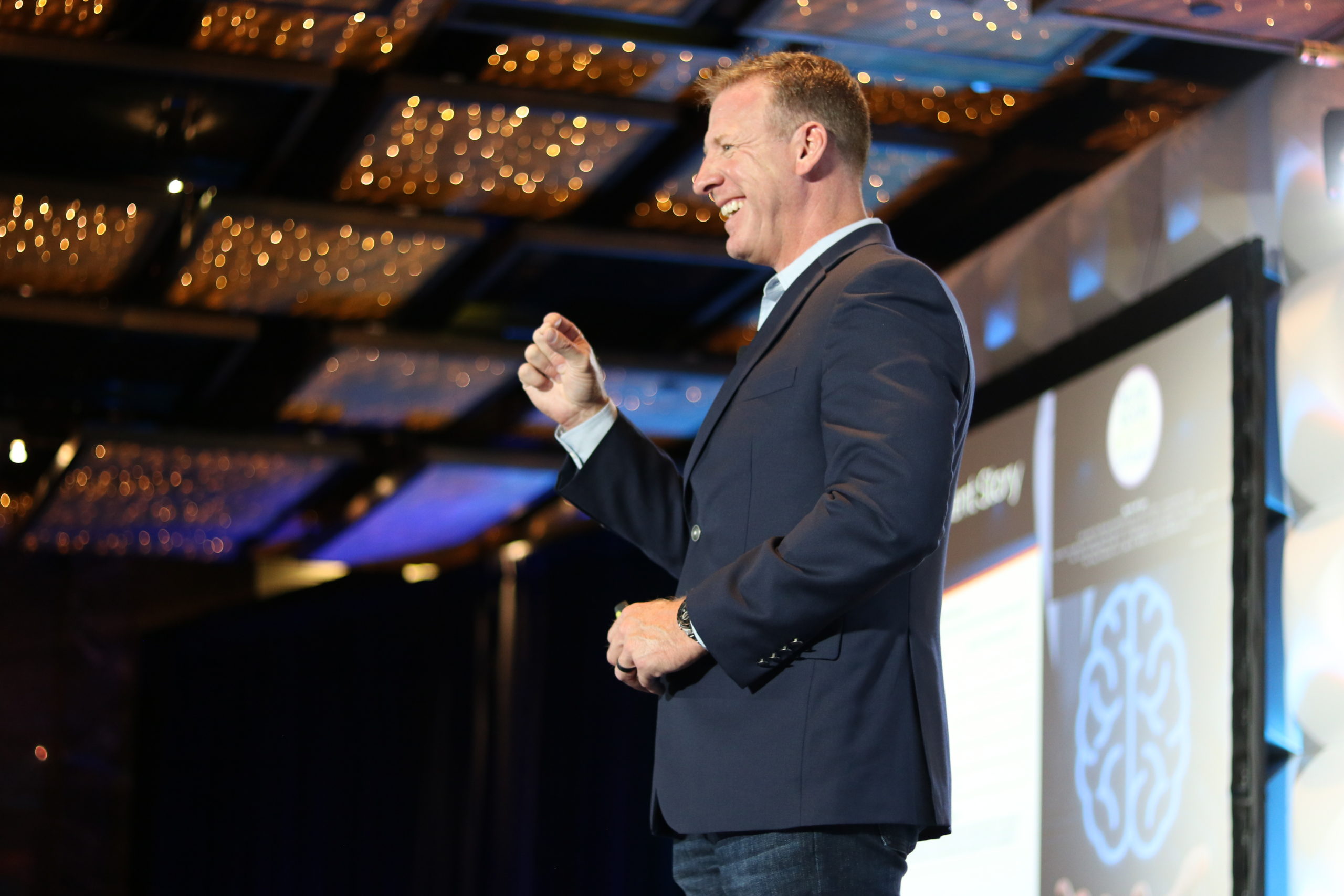
Jeff Bloomfield is a keynote speaker, Wall Street Journal bestselling author, and the founder of Braintrust. He has spent over 20 years helping Fortune 500 sales teams rewire how they communicate, using the neuroscience of trust, decision-making, and buyer behavior to drive results that stick long after the event. He speaks at corporate events, executive summits, and sales kickoffs across life sciences, financial services, software, and technology.
Experience Highlights
- NeuroSelling methodology and enterprise adoption
- Trust-based selling at the executive level
- Sales transformation in complex, long-cycle industries
- Keynote speaking and executive coaching
Areas of Expertise
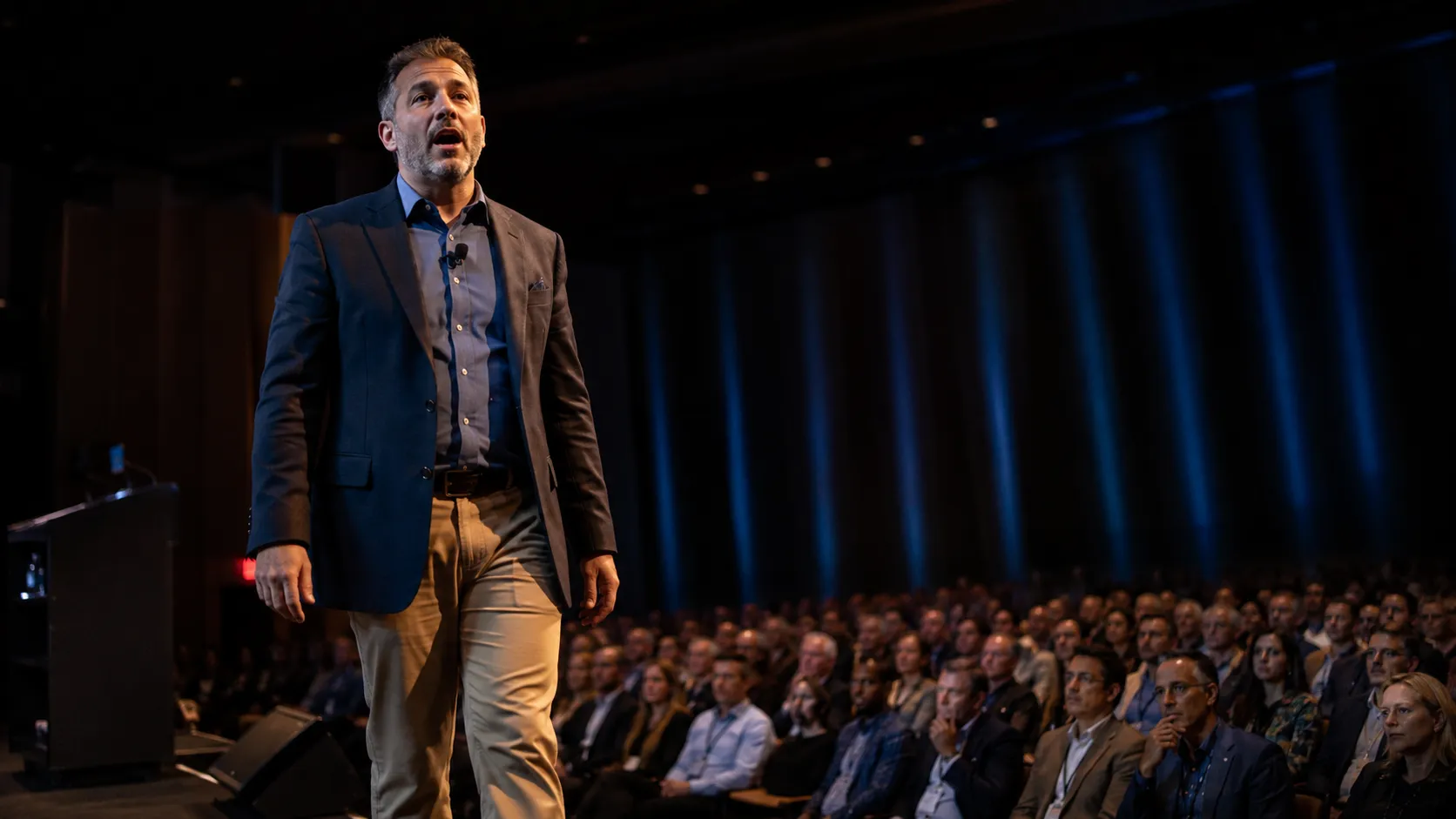
If you are shortlisting a keynote speaker for a sales kickoff, revenue summit, or annual conference, watch the first 90 seconds of the tape before you watch anything else. That window is where an audience decides whether to lean in or reach for a phone, and nothing brilliant in minute forty recovers a room that left in minute one. Here is what the brain resolves in that window, how to build an opening that survives it, and how to evaluate a speaker's opening before you sign.
The Opening Is Not a Warm-Up, It Is the Trust Decision
Most presenters treat the first 90 seconds as runway. Time to settle in, fix the mic, thank the host.
The room is not settling in. The room is deciding.
Your audience runs a fast, unconscious evaluation of the person on stage, and it closes long before your first real point lands. Everything after gets filtered through that verdict. A speaker who clears the check gets curiosity. A speaker who does not gets politeness, phones, and a slow attention leak no strong middle section reverses.
So the opening deserves more preparation than any other part of a talk, and it is the most useful thing to evaluate when you choose who goes in front of your people.
"Jeff's keynote captivated the audience within the first three minutes! Post-conference feedback was incredible. 100% success!"
Kate Genovese, SVP, Risk Strategies
What the Brain Is Actually Resolving in Those First Moments
Three questions get answered before your audience consciously decides to listen. The order does not negotiate.
One: am I safe here. Not physically. Socially. Is this going to waste my afternoon, embarrass me, or ask something of me I did not agree to. The brain runs a threat check before a reasoning check, and until it clears, nothing you say gets full processing.
Two: can I trust this person. In a Princeton study, people judged a face's trustworthiness in roughly a tenth of a second, the fastest and most consistently judged trait tested. Not competence. Not likability. Trustworthiness. Your audience has a working answer on that question before you finish your first sentence, and credibility gets evaluated afterward, on top of it.
Three: does this concern me. Relevance is the gate to attention. A room of sellers who have missed two quarters wants to know whether the next 45 minutes touch their actual problem. Generic openings answer no.
Notice what is absent. Nobody is asking about your bio or how honored you are to be here.
Why Story Clears the Gate That Data Cannot
The strongest openings are narrative rather than informational, because the brain treats the two differently at the hardware level.
Narrative activates seven brain regions. Data alone activates two. That gap separates a room that is decoding from a room that is experiencing. Stories are also 22 times more memorable than facts alone, which matters when your goal is behavior that survives the flight home.
Add the persuasion layer. Roughly 95% of persuasion happens at the unconscious level, and the average attention span now sits near 8 seconds, down from 12 before smartphones. You are not opening into a patient room.
Story speaks to both realities at once. It buys attention through tension and earns trust through disclosure.
"I have never seen anyone combine storytelling, science and sales in such a unique way!"
Dave Nurre, VP of Sales, USI Insurance
The Four Beats of an Opening That Earns the Room
An opening is not a mood. It is a sequence with jobs, and each beat answers one question the brain is already asking.
Beat one: the disruption. Say something the room did not predict. The brain allocates attention to prediction errors, so an opening that matches expectations gets filed as background. A hard statistic delivered flat. A first line that sounds like the middle of a story. What it cannot be is a preamble.
Beat two: the stakes. Name what is at risk for these specific people today. Not the industry. This room, this quarter, this number. Loss aversion runs about five times stronger than the desire for gain, so the cost of standing still lands harder than the upside of moving.
Beat three: the personal admission. Tell a short moment where something cost you. Not a humblebrag, not a setback that turns into a trophy in the same sentence. Disclosure converts a credentialed stranger into a person the room will follow, because it signals you are not managing them. Most presenters skip this beat. It does the most work.
Beat four: the promise. State plainly what they will do differently when you finish. One sentence, concrete enough to be falsifiable. It gives the brain a reason to stay and sets the contract you close against at the end.
Four beats. Ninety seconds. Everything after gets easier if those land.
A 90-Second Beat Sheet You Can Time
Here is the structure with clocks on it. Use it to build an opening, or to time a demo reel.
0:00 to 0:10 | The disruption. First words out. No greeting, no housekeeping. A line that creates a prediction error and makes the room look up.
0:10 to 0:30 | The stakes, made local. Name the pressure this audience is under, in their language. If a stranger could deliver this passage anywhere, it is not local enough.
0:30 to 1:00 | The personal admission. The moment it cost you something. Specific detail, plain delivery, no rescue at the end. Longer than thirty seconds feels like a performance.
1:00 to 1:15 | The bridge. Connect your moment to theirs in a sentence or two. This is where the room realizes the story was never about you.
1:15 to 1:30 | The promise. What they will do differently, then straight into the body without pausing for applause.
Notice what still has not happened at 90 seconds. No thanks, no credential, no agenda. All three can come later, once the room has decided you are worth listening to. All three land better there.
Openings That Underperform, and What Is Actually Going Wrong
Each of the four below is a technique someone was taught, for a sound reason. The technique is not the problem. The problem is what happens to it under live pressure, in a room it was never tailored to.
The agenda slide. Taught for orientation, which is a real need in a working session. As an opening beat it answers a logistics question before the trust question, and the brain files logistics as low priority. Move it to minute three.
The thank-you throat clear. Taught as courtesy, and courtesy is correct. It just cannot occupy your first 20 seconds, because the room hears a talk that has not started yet. Thank the host after your first substantive beat and it reads as warmth instead of stalling.
The credentials recital. Taught to establish authority, and authority matters to a skeptical audience. The gap is that a room forms a general first impression in about 0.07 seconds, on presence and behavior, well before it processes a resume. Listing accomplishments asks the room to reconsider an impression it has already formed. Let the host read the bio.
The joke with no bridge. Taught for rapport, which is the right goal. Humor works when it carries the point. It underperforms when it is decorative, because the laugh resets to zero and you still have to start.
None of these are failures of skill, or of the programs that teach them. They are failures of context. A technique that works in a rehearsal room, with a friendly coach and no adrenaline, has to survive a dark ballroom, a cold audience, a delayed start, and a heart rate at 110. Under that pressure people default to the most familiar opening available, which is almost always the least specific one.
Opening Moves and What the Brain Does With Them
| Opening Move | What the Brain Does With It | When to Use It | What It Costs When Misplaced |
|---|---|---|---|
| Cold open story, mid-scene | Registers narrative, engages seven regions, suspends judgment until it resolves | Almost always, especially with veteran or skeptical audiences | Little, if the story pays off inside 60 seconds |
| Prediction-breaking statistic, delivered flat | Flags a prediction error, reallocates attention forward | When the audience believes the problem is already solved | Becomes trivia if you do not name who it happens to |
| Direct question to the room | Shifts listeners from passive to participatory | Mid-size rooms, breakouts, workshop formats | In a big ballroom, silence reads as a failed bid |
| Personal admission of cost | Reads disclosure as safety, turns a stranger into a person | After a disruption has bought attention | Cold vulnerability, with no tension first, reads as self-focus |
| Agenda, housekeeping, credentials | Files as administrative, deprioritizes, drifts | Minute three onward, once trust has resolved | Spends the highest-attention window on the lowest-value content |
How I Build an Opening for a Specific Audience
My opening is the last thing I write and the first thing I test.
I start from the audience, not the content. Every booking includes a pre-event customization call, and I need it before I can write beat two. A sales organization coming off a strong year needs a different opening than one that has missed two quarters, and a room told attendance was mandatory needs a different first ten seconds than a room that chose to be there. Same science, different door.
So I ask what happened in the 90 days before the event, what leadership is worried about but has not said out loud, and what the last speaker did. Then I build a disruption that only makes sense to that room.
For the personal admission I use a real one. A farm upbringing in central Ohio, years running commercial launches for genetic cancer therapies, then hearing the word cancer applied to me. Those moments are not decoration. They are the reason a room of experienced sellers lets a stranger tell them how their own brain works.
That is why 100% of my talks are custom-built rather than pulled off a shelf. A keynote that opens generically spends its most valuable 90 seconds proving it could have been delivered anywhere. In a full storytelling keynote, the opening is where customization shows first.
Coaching Your Own Presenters to Open Better
Most leaders reading this also want to raise the floor on how their own team opens a QBR, a customer meeting, or a stage segment at the kickoff.
If you have already invested in presentation or communication training for that team, keep it. That was the right call, and the technique inside it is sound. What any curriculum needs alongside it is the audience-specific context and the live pressure rehearsal that make an opening land in the actual room. That is a conditions problem, not a content problem.
Three things close it:
- Rehearse the first 90 seconds ten times more than the rest. The opening, standing, out loud, cold. Muscle memory survives adrenaline.
- Make the stakes beat un-reusable. Beat two gets rewritten for every audience. If it survives a copy and paste, it was never local.
- Give the team shared language for the beats. Name them, coach to the names, have managers reinforce them in one-on-ones.
A keynote does that at scale in one hour. The room watches the structure work on itself in real time, so the names your coaching uses arrive already attached to a moment everyone lived through. That shared reference point is what your coaching afterward gets to build on.
How to Evaluate a Speaker's Opening Before You Book
You do not need a full talk to know what you are buying. You need 90 seconds and a stopwatch.
In the demo reel:
- Start the clock at the first word. How long until something substantive happens. If the first 20 seconds are thanks and housekeeping, that is the default under pressure, and pressure runs higher at your event.
- Ask for one unedited continuous opening. First three minutes, real audience, no cuts. Reels splice the best moments, and a speaker with a reliable opening has the raw clip on hand.
- Watch the audience, not the speaker. Look for heads up, bodies forward, phones down inside two minutes.
- Listen for specificity. If those 90 seconds would drop into any conference, expect to receive the same 90 seconds.
On the call:
- Ask what they need from you to build it. A speaker who wants a customization call, attendee context, and time with your leaders is building beat two properly.
- Ask how they would open for your audience. Listen for questions, not a pitch.
- Ask for a reference from a difficult room: mandatory attendance, an early slot after a late night, a session after hard news.
That last one is the real test. Any competent presenter can open a warm room. The opening you are paying for works when the room arrives skeptical. The same criteria apply to a kickoff or an association conference keynote, because the brain in seat 300 runs the same three checks either way.
Frequently Asked Questions
How do you open a presentation to grab attention?
Open with a disruption, something the audience did not predict, in your first ten seconds with no greeting in front of it. Then name the stakes for that room, share a short moment that cost you something, and state one concrete promise. Attention is captured or lost in about five seconds.
How long should the opening of a keynote be?
About 90 seconds for the trust-building sequence, then straight into the body. That covers four beats at roughly 10, 20, 30, and 15 seconds, plus a bridge. Anything longer reads as preamble, and the room has already decided.
What is the best way to open a sales presentation?
Lead with the buyer's situation, not your company. Open on a tension they recognize from their own quarter, make the cost of standing still concrete, then earn the right to speak with a short honest disclosure. Loss aversion runs roughly five times stronger than the desire for gain.
Should I thank the audience or the host at the start?
Thank them, just not first. Gratitude is worth expressing, but in your opening 20 seconds it signals a talk that has not started. Deliver the disruption and stakes beats, then thank the host at the first natural break, where it reads as warmth instead of stalling.
How does Jeff Bloomfield build the opening for a specific event?
Jeff builds it backward from the audience, on a pre-event customization call that comes with every booking. He asks what happened in the 90 days before the event, what leadership is worried about, and how the room was told to attend. 100% of his talks are custom-built, and the opening is where that shows first.
What should I look for in a speaker's demo reel before booking?
Time the first 90 seconds and watch the audience rather than the speaker. Ask for one unedited opening from a real event, check whether the language is specific to that audience, and request a reference from a difficult room.
If you are deciding who opens your next kickoff or conference and want to hear how the first 90 seconds would be built for your specific room, it is worth a conversation. Reach out directly to check dates and talk through the audience.
Keynote Speaker
Jeff delivers keynotes at sales kickoffs, leadership summits, and corporate conferences, combining neuroscience, storytelling, and real-world selling experience into sessions that move people and stick long after the event ends.
