
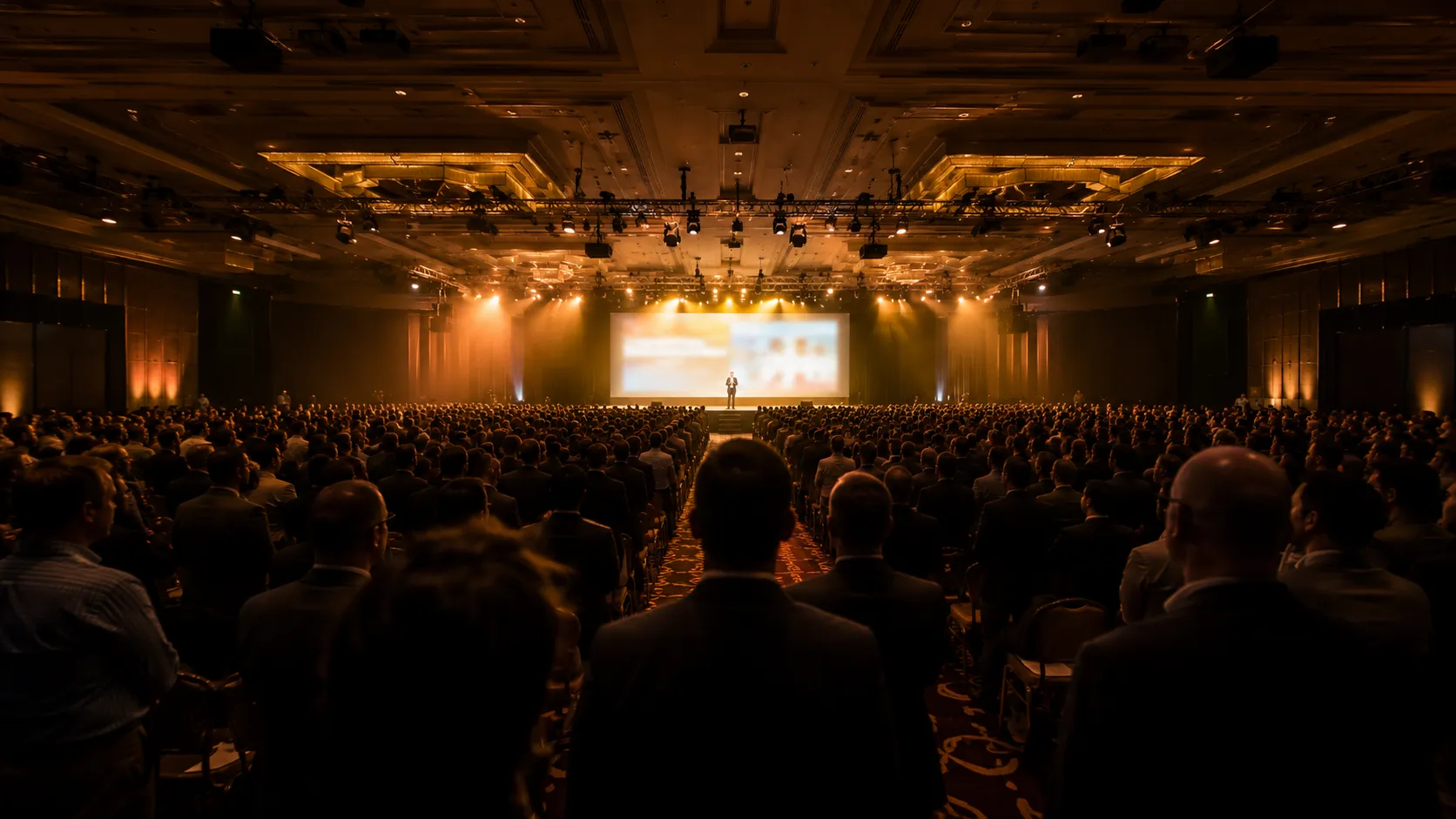
Opening Keynote vs. Closing Keynote: Which Slot Should Your Headliner Own?

About
Jeff Bloomfield is a keynote speaker, Wall Street Journal bestselling author, and the founder of Braintrust. He has spent over 20 years helping Fortune 500 sales teams rewire how they communicate, using the neuroscience of trust, decision-making, and buyer behavior to drive results that training alone rarely produces. He speaks at corporate events, executive summits, and sales kickoffs across life sciences, financial services, software, and technology.
Experience Highlights
- 500+ keynotes delivered to Fortune 500 and association audiences
- Wall Street Journal bestselling author
- Former biotech executive who led launches for genetic cancer therapies
- 20+ years of Fortune 500 experience
- Founder of Braintrust
Areas of Expertise
Should the keynote be at the beginning or end of a conference? In practice, most planners answer that question with budget and speaker availability, then build the rationale afterward. There is a better way to decide, and it starts with a different question: what job does this talk actually need to do? The opening keynote vs. closing keynote choice is not about prestige or running order. An opening keynote installs the interpretive frame that every session afterward gets filtered through. A closing keynote consolidates what the audience already absorbed and converts it into commitment. Those are two different neurological jobs, and they call for two different talk designs.
What an Opening Keynote Is For
An opening keynote is the first general session of a conference, and its job is framing. Not warming up the room. Framing.
Whatever the opening speaker teaches the audience to pay attention to becomes the lens for the next two days. If the opening keynote is about trust, attendees walk into a breakout on pipeline metrics and hear a trust problem. If the opening keynote is a product roadmap, they hear a feature gap. Same breakout, different conference.
The opening slot also carries a credibility function that planners often underestimate. Attendees arrive with a question they will not say out loud: is this worth the three days I gave up? The opening keynote answers that question for the entire event, favorably or not, and the answer is very hard to revise later.
Choose the opening slot when:
- You need a shared vocabulary before breakouts, tracks, or workshops begin
- The event has a theme that needs to be made real rather than announced
- You are asking the audience to think differently, and that reframe needs runway to be applied
- Attendance is highest on day one, which is true at most multi-day conferences
- Leadership will speak later and needs the ground prepared for a hard message
What a Closing Keynote Is For
A closing keynote is the final general session, and its job is consolidation and conversion. The audience arrives already full. They have been given more material in 48 hours than they can process, and they are quietly sorting it into two piles: things I will do, and things I heard.
The closing keynote decides how much lands in the first pile.
That is the strategic weight of the closing slot. It is the last thing anyone hears, so it is the thing they repeat in the office on Monday. It is also the hardest room in the building: people are tired, some have already checked out of their hotels, and the exits are visible.
Choose the closing slot when:
- The event has covered a lot of ground and needs somebody to tie the threads together
- You need a specific behavioral commitment, not general enthusiasm
- Attendee retention and renewal are the metrics you are actually being measured on
- Earlier content was heavy, technical, or difficult, and the room needs a reason to feel capable rather than overwhelmed
- The event ends on a decision, a vote, a launch, or a call to action
Opening vs. Closing: A Side-by-Side Comparison
| Decision Criterion | Opening Keynote | Closing Keynote |
|---|---|---|
| Primary job | Install the frame everything else gets read through | Consolidate what was absorbed and convert it to commitment |
| Audience state | Fresh, curious, and quietly skeptical | Saturated, sorting, partially departed |
| Cognitive capacity | High capacity, low context | High context, low capacity |
| What the talk must add | A new model or lens the audience did not walk in with | Fewer things, not more, plus a reason to act on them |
| What success looks like an hour later | Attendees are using the speaker's language in breakouts | Attendees are naming one specific thing they will change |
| Design requirement | Simple, memorable, portable structure that survives two days | Live synthesis that references what actually happened at the event |
| Biggest risk if it misses | Every following session gets read through the wrong lens | The event evaporates on the drive home |
| Energy curve required | Build attention from a cold start | Recapture attention from a distracted, tired room |
| Agenda support needed | Nothing heavy scheduled before it | Nothing after it except a fast, warm goodbye |
| Speaker profile that fits | Can teach a model clearly and set tone in ten minutes | Can adapt live, reference earlier sessions, and land a specific ask |
How Audience State Changes the Talk Design
This is the part that gets skipped. Planners compare slots as if the talk is a fixed object that can be dropped into either one. It is not.
An opening audience has capacity but no context. They can absorb a new framework, hold a counterintuitive idea, and follow a longer arc, because nothing has been spent yet. What they lack is any shared reference point, so the opening keynote has to build one from scratch.
A closing audience is the inverse. They have two days of shared reference and almost no capacity left.
Which means the single most common closing-keynote failure is trying to add a new framework at the end. The room cannot hold it. A closing keynote that works does the opposite: it subtracts. It picks up two or three threads the audience already heard, connects them into one idea, and attaches a specific action to it. Reduction feels like relief to a saturated brain, and relief is what makes a message portable.
There is a memory dimension too. People recall the beginning and the end of an experience far more vividly than the middle. That is not an argument for either slot. It is an argument for being deliberate about what you want remembered.
How the Agenda Around the Slot Changes the Outcome
A keynote does not perform in a vacuum. What you schedule around it can quietly undo it.
| Agenda Condition | What It Does to the Keynote | What to Change |
|---|---|---|
| 40 minutes of housekeeping and sponsor thanks before the opening keynote | The room is already flat when the speaker walks out | Cap pre-keynote logistics at eight minutes and move sponsor recognition to lunch |
| Opening keynote followed immediately by a product roadmap session | The frame gets overwritten before it can be applied | Put a discussion-based or interactive session next so attendees use the new language |
| Closing keynote scheduled after an awards banquet or late social event | Half the room is running on four hours of sleep | Either move the keynote earlier or shorten it and raise its energy floor |
| Closing keynote placed after the hotel checkout deadline | Attendance drops before the most important talk | Negotiate a late checkout block or move the keynote before the lunch break |
| Logistics announcements after the closing keynote | The last thing anyone hears is a shuttle schedule | Announce logistics before the keynote and end on the keynote itself |
| No breaks in the four hours before a closing keynote | Cognitive load is maxed out before the speaker begins | Insert a 20 minute unstructured break, not another session |
The pattern in every row is the same: protect the slot you paid for. The cheapest way to raise the return on a keynote fee is to fix the 30 minutes on either side of it.
The Two-Keynote Structure and When It Is Worth the Budget
Booking both slots is the strongest structure available, and the one most often dismissed on cost before anyone runs the math.
The bookend works because the opening installs a frame and the close proves the audience can act on it. When the two talks are related, the middle of the conference stops feeling like a collection of sessions and starts feeling like an argument with a conclusion.
It is worth the budget when the event runs multiple days, spans multiple tracks, and carries a real behavior change ask. It is worth less at a single-day, single-track event under about 150 attendees, where one strong general session plus a well-run close does the same work.
There is also a middle option most planners never ask about: one speaker holding both slots. A 45 minute opening keynote that installs the model, plus a 20 to 25 minute closing session that lands it, costs meaningfully less than two headliners and often outperforms them, because the close can reference the opening instead of competing with it. I do this structure regularly, and it is what I recommend when a client wants a bookend on a single-headliner budget.
What Should Change in the Speaker Profile
Different slot, different skill set. The opening requires someone who can teach a model cleanly to a cold room and set a tone the rest of the agenda can live inside. The closing requires something harder: the ability to sit through the event, listen to what actually happened, and rebuild the last 20 minutes of the talk around it in real time.
That second capability is the one to interview for. Ask a prospective closing speaker what they will do differently based on what happens in the two days before they go on. A vague answer means you are buying a talk that would have been identical at any event, which is exactly what a saturated room can smell.
My approach is the reason 100% of my talks are custom-built rather than pulled off a shelf. Across 500+ keynotes, the pre-event customization call is where the real work happens: what the room already believes, what leadership is about to ask of them, what the last three years have cost them. Whether the material comes from the sales side of my work in NeuroSelling® or the leadership side in NeuroCoaching®, the neuroscience underneath does not change. What changes is what the room needs when I walk out.
"Jeff's dynamic presentation set the tone for our entire conference. Jeff was proclaimed as the most outstanding keynote speaker we've ever featured!"
— Kathy Thiel, Chairman, M&A Source
If you are scoping either slot, the conference keynote page covers formats, session lengths, and audience types, and Jeff's background covers the Fortune 500 and biotech experience the material comes out of.
Five Mistakes That Waste the Slot
- Deciding by availability and calling it strategy. If the speaker could only do Thursday afternoon, say that out loud internally. Then design the talk for Thursday afternoon instead of pretending you chose it.
- Putting the biggest name in the opening slot by default. Star power is not the same as framing ability. The best opening keynote is the one that makes the next two days make sense.
- Treating the closing keynote as entertainment. A room that is tired does not need to be amused, it needs to be given one thing to do. Enthusiasm without a specific ask evaporates in the parking lot.
- Briefing both slots identically. If the opening and closing speakers get the same brief, you will get two talks that overlap and neither will do its job.
- Leaving the last word to logistics. The final voice the audience hears should be the message, not the shuttle schedule.
A Five-Question Decision Framework
Run these in order. The first clear answer decides the slot.
- Does the audience need a shared lens before the rest of the agenda will work? If yes, open. This overrides everything else, because a missing frame cannot be retrofitted on day two.
- Is the event's purpose informational or behavioral? Informational events benefit more from a strong opening. Behavioral events, where you need people to do something different next quarter, benefit more from a strong close.
- Where is attendance highest? Book the slot with the most bodies in seats. At most multi-day conferences that is the morning of day one, which is a real argument for opening.
- What are you actually measured on? If it is satisfaction scores and renewal, weight the close, because it is the last input into both. If it is engagement across sessions, weight the opening.
- Can your agenda protect the slot? A closing keynote after checkout, in a half-empty room, is worse than an opening keynote in a full one. Choose the slot you can defend.
If two answers point in opposite directions and the budget allows it, that is your signal to look seriously at the bookend structure rather than forcing a compromise.
Frequently Asked Questions
Should the keynote be at the beginning or end of a conference?
It depends on what the talk needs to accomplish. Open with the keynote when the audience needs a shared frame before breakouts and sessions begin, and close with it when the event needs to convert two days of content into a specific commitment. If you are measured on attendee retention and renewal, weight the closing slot, because it is the last thing anyone hears.
Is an opening or closing keynote more expensive?
Fees are usually the same for either slot, because the fee reflects the speaker rather than the position on the agenda. What differs is total cost: a closing keynote often requires an extra travel night and, for speakers who genuinely customize, time spent attending earlier sessions. Ask how the speaker prices that attendance, because it is where the real difference shows up.
Can the same speaker do both the opening and closing keynote?
Yes, and it is frequently the best value on the agenda. A full opening keynote paired with a shorter closing session lets the second talk build directly on the first instead of competing with it. Jeff Bloomfield uses this structure regularly for multi-day conferences that want a bookend on a single-headliner budget.
How long should an opening keynote be versus a closing keynote?
Opening keynotes typically run 45 to 60 minutes, because the room has the capacity for a full arc and you are establishing something the rest of the event will use. Closing keynotes work better at 30 to 45 minutes, since attention is scarce and the job is reduction rather than introduction. Anything past an hour in the final slot fights the room.
What if we put our strongest speaker at the end and people leave early?
That is an agenda problem, not a speaker problem, and it is fixable. Negotiate a late checkout block with the hotel, move the closing keynote before the last lunch, and announce all travel logistics before the talk rather than after it. If none of those are possible, move the strong speaker to the opening slot.
Does a closing keynote need to summarize the whole conference?
No, and attempting it is a common failure. Summarizing sounds like a recap and gets tuned out. Jeff's practice is to pick up two or three specific threads that actually surfaced during the event, connect them into a single idea, and attach one concrete action to it.
Book the Slot That Does the Job
The right slot is the one that matches what your event needs to accomplish, and that is worth a conversation before you sign anything. Start a conversation about which slot fits your agenda and what the talk should be built to do.
Keynote Speaker
Jeff delivers keynotes at sales kickoffs, leadership summits, and corporate conferences — combining neuroscience, storytelling, and real-world selling experience into sessions that move people and stick long after the event ends.
