

How to Frame AI for Your Workforce Without Creating Fear
About
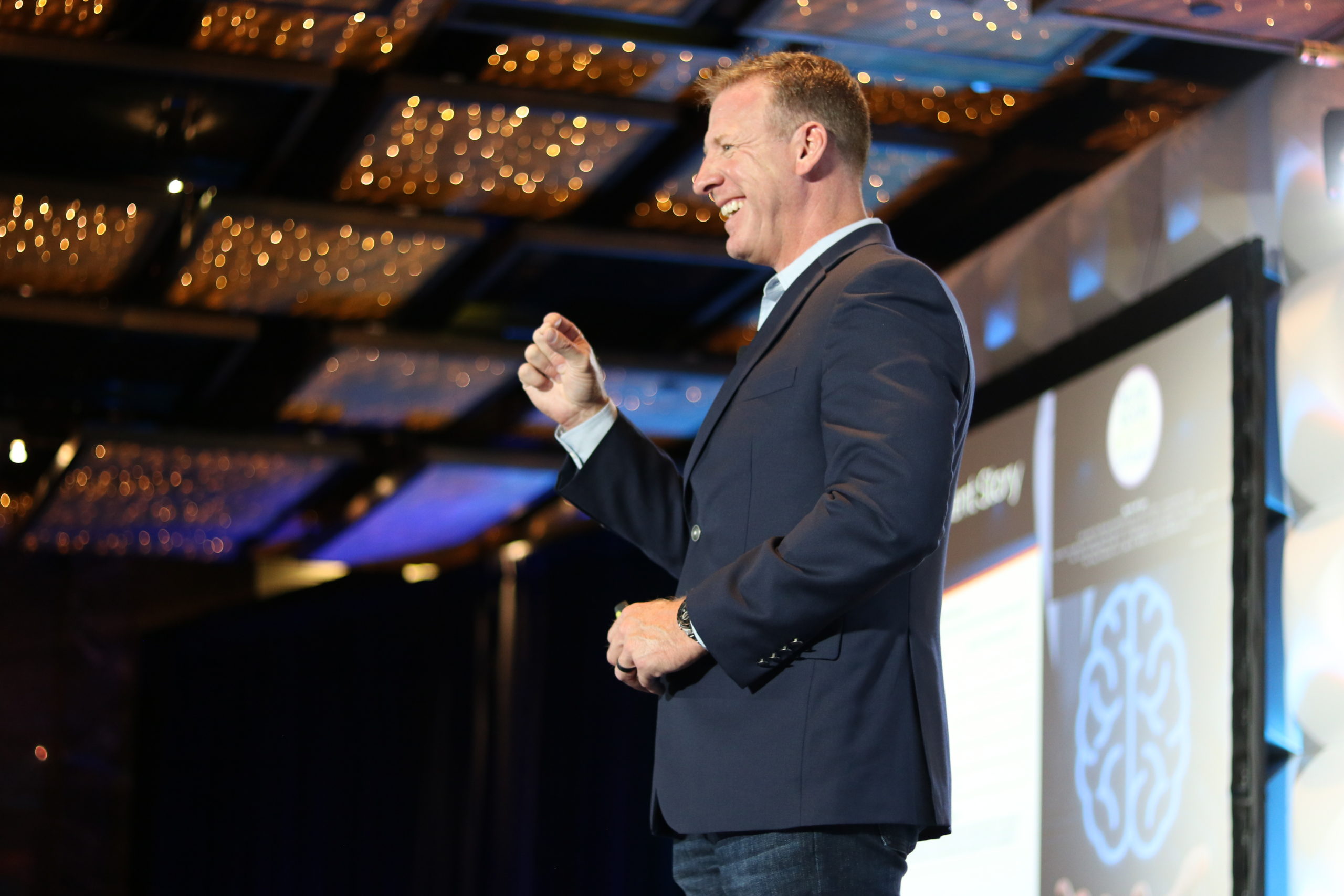
Jeff Bloomfield is a keynote speaker, Wall Street Journal bestselling author, and the founder of Braintrust. He has spent over 20 years helping Fortune 500 sales teams rewire how they communicate, using the neuroscience of trust, decision-making, and buyer behavior to drive results that training alone rarely produces. He speaks at corporate events, executive summits, and sales kickoffs across life sciences, financial services, software, and technology.
Experience Highlights
- 500+ keynotes delivered to Fortune 500 and association audiences
- Wall Street Journal bestselling author
- Former biotech executive who led launches for genetic cancer therapies
- 20+ years of Fortune 500 experience
- Founder of Braintrust
Areas of Expertise
The way a company announces AI shapes how employees experience the next two years of change. Say it wrong, even once, and the brain locks onto threat before it ever hears the plan. Get the framing right, and the same rollout becomes a story people want to be part of.
This isn't a messaging problem you solve with a slicker slide deck. It's a brain problem, and it responds to a different kind of framing than most companies use.
Why AI Announcements Trigger Fear Before They Trigger Curiosity
The human brain is wired to treat ambiguous change as danger until proven otherwise. When a leader says "we're rolling out AI across the organization" without saying what that means for specific roles, the brain doesn't wait for more information. It fills the gap with the worst-case story, because that's the safer assumption evolutionarily. This is why a vague AI announcement generates more anxiety than a detailed one, even when the detailed one includes hard truths.
Threat response, in this context, refers to the brain's automatic shift into a defensive, self-protective state when it detects uncertainty about safety, status, or resources. A job is all three at once. Once an employee's brain tips into threat response, they stop listening for information and start scanning for confirmation of the danger. Every ambiguous sentence in the town hall gets read as evidence, not context.
This is the core reason AI rollouts stall internally even when the technology itself works. Leaders often blame adoption problems on training or tools. In most cases, the real issue happened weeks earlier, in the way the initiative was first framed.
The Framing Mistake Most Leaders Make
Most companies default to one of two failed approaches: the technical demo or the blanket reassurance. Neither addresses what the brain is actually asking, which is "what does this mean for me, specifically, starting Monday."
| Old Framing | Brain-Aligned Framing |
|---|---|
| "AI will transform how we work" | "Here's what changes in your role, and what stays the same" |
| "Don't worry, no one is losing their job" | "Here's exactly which tasks shift to AI and which stay with you" |
| A live tool demo with no context | A before/after view of the actual workflow, task by task |
| One all-company message for everyone | A core message plus role-specific detail for frontline, manager, and executive audiences |
| Silence between the announcement and the rollout | A visible sequence: announcement, training, tool access, check-in |
The brain-aligned column isn't softer. It's more specific. Specificity is what lets the threat response stand down, because specificity is what a vague threat can't survive.
What AI Anxiety Actually Costs the Organization
Leaders sometimes treat employee AI anxiety as a soft-skills issue, something HR handles on the side while the "real" rollout proceeds. That underestimates the cost. Anxious employees disengage from the tools they're supposed to be adopting, quietly route around new workflows, and share their skepticism with peers who haven't yet formed an opinion. The rollout looks technically complete and functionally stalled.
The scale of the underlying shift is real, which is exactly why vague messaging backfires. The World Economic Forum projects 85 million jobs displaced by AI by 2028, alongside 97 million new roles created that require distinctly human skills. Read separately, the first number is frightening. Read together, they describe a labor market in transition, not a labor market in collapse. Most internal AI communications quote the displacement number, if they quote either, and skip the creation number entirely. That is an unforced error. Leaders who cite both figures are more credible, because employees can tell when they're being handed a partial picture.
Job transformation, as distinct from job elimination, describes the more common pattern inside most organizations: a role's task mix shifts as AI absorbs repetitive or data-heavy components, while the parts of the job that require judgment, relationship, and context become a larger share of what the person actually does day to day. Naming this distinction explicitly, rather than assuming employees will infer it, is one of the highest-leverage moves in an AI communication plan.
The Four Elements of a Fear-Reducing AI Message
A message that reduces fear rather than triggering it tends to share four elements, regardless of industry or company size.
- Name the fear before the employee has to. Say "we know this raises questions about job security" out loud, rather than hoping the positive framing distracts from it. Naming a fear reduces its charge; avoiding it amplifies it.
- Be specific about what changes and what doesn't. Vague statements about "transformation" read as evasive. Specific statements about which tasks shift and which don't read as honest, even when the news is mixed.
- Show the sequence, not just the announcement. Employees who can see the path (announcement, training, tool access, check-in points) experience less anxiety than employees who only see a single event with no visible follow-through.
- Emphasize the skills that become more valuable, not just the tasks that get automated. People need to hear what they're moving toward, not only what they're moving away from.
How to Talk About Job Displacement Honestly
Employees can tell the difference between reassurance and honesty within the first thirty seconds of a talk. If your organization is genuinely not planning layoffs tied to AI adoption, say that plainly and explain why, tied to the actual business case. If some roles will shrink or consolidate over time, say that too, along with the timeline and the support available. What erodes trust fastest is language that sounds like reassurance but leaves enough wiggle room that employees later feel misled.
A useful test before any AI communication goes out: if a skeptical employee read this message six months from now, after some roles had in fact changed, would they feel the message was honest or would they feel it was managed? Messages built to survive that test tend to hold up during the actual transition, not just during the announcement.
Segment the Message: Frontline, Manager, and Executive Concerns Are Different
A single AI message sent to an entire organization misses most of the room, because different groups are afraid of different things. Frontline employees tend to worry about job security first. Managers worry about how to lead a team through a transition they don't fully understand yet themselves. Executives worry about competitive disruption and the pace of the business case. Treating all three as one audience wastes the specificity that actually reduces anxiety.
| Audience | Primary Concern | What the Message Should Address |
|---|---|---|
| Frontline employees | Job security, task displacement | Which specific tasks change, what training looks like, what stays the same |
| Middle managers | How to lead the transition, answer questions they can't yet answer | Talking points, escalation paths, what they're allowed to promise |
| Senior executives | Competitive pace, ROI, organizational risk | Business case specifics, timeline, how success will be measured |
| HR and People teams | Employee sentiment, retention risk, legal exposure | Data on adoption and sentiment, policy clarity, support resources |
Segmenting the message doesn't mean contradicting it across groups. The core facts stay consistent. What changes is which facts get emphasized and how much context each group receives before the same core message reaches them.
A Step-by-Step Script for Your Next AI Town Hall or All-Hands
- Open with the business reason, not the technology. Explain the problem AI is solving before describing the tool itself.
- Name the anxiety in the room directly. A single sentence acknowledging that this raises real questions does more than an hour of forced positivity.
- Show the before-and-after for a real workflow, ideally one the audience recognizes from their own day. Abstract examples don't land the way a familiar one does.
- State plainly what is and isn't changing about job security, using language that would hold up under scrutiny later.
- Walk through the sequence, from this announcement through training, tool rollout, and the first scheduled check-in.
- Leave real time for questions, including ones leadership can't fully answer yet. Saying "we don't have that answer yet, here's when we will" preserves more trust than a confident but hollow answer.
- Follow up in writing within 48 hours, restating the key points so employees who process the news slowly still get the specifics.
Sequencing the Rollout So Silence Doesn't Fill the Gap
Ambiguity about what happens after the announcement breeds more anxiety than almost anything said during the announcement itself. Employees who understand the sequence, keynote or town hall, then training, then tool rollout, then scheduled check-ins, engage differently than employees left to guess what comes next. The gap between events is where rumor fills in for information.
My approach when I speak to organizations navigating this transition is to treat the keynote or town hall as the middle of a communication effort, not the whole effort. I tell audiences directly that the goal isn't to make AI feel exciting. It's to make the transition feel survivable and, over time, worth engaging with on its own terms. Companies that pair a single AI event with silence before and after it are asking one hour of content to do the work of a much longer change management process. If your organization is planning that kind of event, my AI keynote speaker page walks through how I build that sequencing into the engagement itself, not just the talk.
What Not to Say: Common Framing Mistakes to Avoid
Certain phrases reliably increase anxiety rather than reduce it, even when the intent behind them is good.
- "AI will make everyone's job easier." This sounds hollow to anyone whose job is about to change substantially, and it reads as either naive or dishonest.
- "There's nothing to worry about." Said without specifics, this triggers more suspicion than reassurance. The brain treats blanket reassurance as a red flag, not a comfort.
- "We're still figuring out the details." Repeated across multiple communications, this starts to sound like leadership is hiding something rather than genuinely working through a plan.
- Silence between the initial announcement and the rollout. Nothing fills that silence with good news. It fills with speculation.
- Framing AI adoption purely in terms of efficiency or cost savings, without acknowledging what that means for the people whose roles get more efficient. Employees hear "cost savings" and translate it to "headcount," whether or not that's accurate.
How to Know If Your Message Is Working
Framing is not a one-time event to get right and move on from. Measure it the way you'd measure any other change initiative. Pulse surveys before and after major AI communications can show whether sentiment moved in the intended direction. Manager check-ins, tracked informally or through a simple survey, surface the questions employees are still asking privately that they wouldn't raise in a large town hall. Tool adoption data itself is a signal: teams that received clear, honest framing tend to adopt new AI tools faster than teams that received vague reassurance, because they trust what they were told about why the change is happening.
If sentiment isn't moving after your communication effort, the fix usually isn't more enthusiasm in the next message. It's more specificity, delivered by someone the audience already trusts, addressing the exact concern the data shows is still unresolved.
Frequently Asked Questions
How do I tell employees about AI without causing panic?
Lead with a specific business reason, name the anxiety directly rather than avoiding it, and be precise about which tasks change versus which stay the same. Vague reassurance triggers more suspicion than honest specificity, even when the news includes some hard truths.
Should I use the WEF stat about 85 million jobs being displaced by AI?
Only if you pair it with the companion figure: 97 million new roles created that require distinctly human skills. Citing displacement without creation tells an incomplete story that reads as alarming rather than informative, and employees notice when a statistic is used selectively.
How do I address AI anxiety differently for frontline employees versus managers?
Frontline employees generally need clarity on job security and specific task changes. Managers need talking points, escalation paths, and clarity on what they're authorized to promise their teams. A single generic message misses both groups' actual concerns.
What's the biggest mistake leaders make when introducing AI to their workforce?
Treating the announcement as a single event rather than the start of a sequence. Employees who don't see a visible path from announcement to training to rollout to follow-up fill that silence with worst-case assumptions.
Is it better to over-communicate or under-communicate during an AI rollout?
Over-communicate, with specifics rather than repetition. Repeating reassurance adds noise. Restating what's changing, what isn't, and what happens next in writing after each conversation gives employees something concrete to hold onto.
How do I know if my AI communication strategy is actually working?
Track sentiment before and after major communications with short pulse surveys, watch tool adoption rates as a behavioral signal, and pay attention to the questions managers report hearing informally. Stalled adoption after a rollout usually points back to a framing gap, not a training gap.
Should HR or the CEO deliver the message about AI adoption?
Both, in sequence. A credible executive establishes the business rationale and the honest picture of what's changing, while HR and direct managers carry the follow-up detail and answer the specific, personal questions employees raise afterward. Neither voice alone covers what the workforce needs to hear.
Worth a Conversation?
If your organization is preparing to introduce AI and wants the framing right from the first announcement, start a conversation with Jeff Bloomfield about what that first message, and the sequence behind it, should look like for your team.
Keynote Speaker
Jeff delivers keynotes at sales kickoffs, leadership summits, and corporate conferences, combining neuroscience, storytelling, and real-world business experience into sessions that move people and stick long after the event ends.
