
Virtual vs. In-Person Keynote Speakers: What's Right for Your 2026 Conference?
About
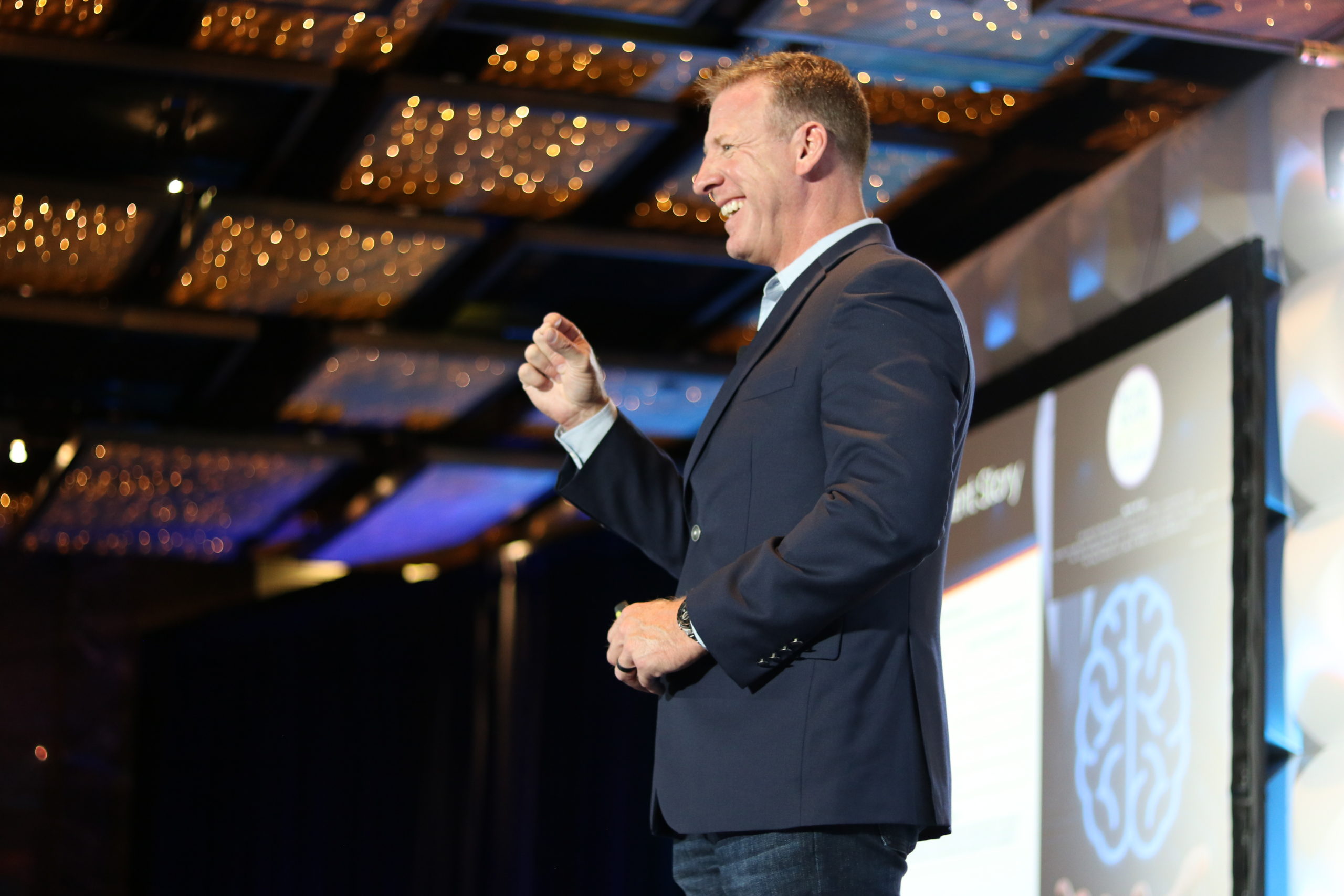
Jeff Bloomfield is a keynote speaker, Wall Street Journal bestselling author, and the founder of Braintrust. He has spent over 20 years helping Fortune 500 sales teams rewire how they communicate, using the neuroscience of trust, decision-making, and buyer behavior to drive results that training alone rarely produces. He speaks at corporate events, executive summits, and sales kickoffs across life sciences, financial services, software, and technology.
Experience Highlights
- 500+ keynotes delivered across virtual, in-person, and hybrid formats
- 20+ years of Fortune 500 experience
- Wall Street Journal bestselling author
- Former biotech executive who led launches for genetic cancer therapies
Areas of Expertise
Choosing a keynote speaker format is no longer a simple logistics decision. It's a decision about how your audience's brain will actually process the message. The best conferences don't just pick a format because it's convenient or cheaper. They pick the format that matches how their specific audience pays attention, connects, and remembers what they heard.
The keynote is the number one factor in conference satisfaction, and 72% of attendees say the keynote determines whether they return to a conference next year. That means the format question isn't a footnote in your planning. It's central to it.
This guide breaks down virtual, in-person, and hybrid keynote formats side by side, and explains the brain science behind why presence and delivery format change what your audience actually retains.
What Is a Virtual Keynote?
A virtual keynote is a live or pre-recorded presentation delivered remotely to an audience watching through a screen, whether that's a webinar platform, a livestream, or a video conferencing tool embedded into a larger virtual event.
| Characteristic | Detail |
|---|---|
| Delivery | Remote, screen-based |
| Typical duration | 20 to 45 minutes, often shorter than in-person |
| Audience reach | Unlimited, not bound by venue capacity |
| Setup requirement | Studio-grade AV on the speaker's end, reliable platform on the planner's end |
| Best fit | Global or dispersed teams, budget-conscious events, time-zone-spanning audiences |
Virtual keynotes remove travel and venue constraints entirely. That's the appeal. But it also means the speaker is competing with every other tab, notification, and open browser window on the attendee's screen.
What Is an In-Person Keynote?
An in-person keynote is a live presentation delivered on-site, in the same physical room as the audience, with no screen mediating the connection between speaker and attendee.
| Characteristic | Detail |
|---|---|
| Delivery | Live, in the room |
| Typical duration | 45 to 60 minutes, sometimes longer with Q&A |
| Audience reach | Limited to venue capacity |
| Setup requirement | Stage, AV production, travel logistics |
| Best fit | Annual conferences, culture-building events, high-stakes audience moments |
In-person keynotes give the speaker the ability to read the room in real time and adjust energy, pacing, and emphasis based on what the audience is actually doing. That feedback loop doesn't exist the same way on a screen.
The Brain Science Behind the Decision
Here's what most event planners miss when they treat this as a cost or convenience decision. The human brain does not process a remote presentation the same way it processes a live one in the room.
Average human attention span is now down to 8 seconds, from 12 seconds before smartphones became constant companions. That decline hits every format, but it hits screen-mediated formats hardest, because a virtual audience has more competing stimuli within arm's reach than an in-person audience does.
My approach to this is grounded in neuroscience, not preference. I've delivered more than 500 keynotes across virtual, in-person, and hybrid formats, and the pattern is consistent: presence changes what the brain prioritizes. In a room, the brain registers shared physical space, synchronized breathing, and collective emotional response, all of which are proven pathways for building trust and connection. On a screen, those cues are muted or missing entirely, so the speaker has to work harder and design differently to earn the same level of attention.
That doesn't mean virtual is worse. It means virtual requires a fundamentally different design, not just a webcam pointed at the same slides used on stage.
Side-by-Side Comparison: Virtual vs. In-Person vs. Hybrid
| Factor | Virtual | In-Person | Hybrid |
|---|---|---|---|
| Cost | Lowest, no travel or venue AV build for the speaker | Highest, includes travel, lodging, and full stage production | Highest overall, since it requires both in-room production and remote broadcast infrastructure |
| Engagement | Requires more frequent interactive touchpoints to hold attention through the screen | Strongest natural engagement through shared physical presence and real-time audience reading | Hardest to sustain, since the speaker must engage two different audiences with two different attention patterns at once |
| Logistics | Simplest, dependent on platform reliability and speaker's studio setup | Most complex, requires venue coordination, staging, and travel scheduling | Most complex overall, combining every in-person requirement with a parallel broadcast production |
| Audience size | Unlimited, scales to any number of remote attendees | Capped by venue capacity | Combines a capped in-room audience with an unlimited remote audience |
| Follow-up / content afterlife | Easiest to repurpose, since the session is typically recorded natively | Requires separate recording equipment to capture reusable content | Naturally recorded through the broadcast feed, giving strong content afterlife with the added benefit of in-room photography and testimonials |
When to Choose Virtual
Virtual is the right call when:
- Your attendees are spread across multiple time zones or countries and travel isn't realistic
- Budget constraints make an in-person keynote fee and travel cost prohibitive
- You need to reach a large or unlimited audience without venue capacity limits
- The event itself is virtual-first, such as an internal all-hands or a webinar series
- You want a recorded asset for internal training or nurture content immediately after the session
When to Choose In-Person
In-person is the right call when:
- The event is your flagship annual conference or association meeting where the keynote sets the tone for everything that follows
- Building culture, trust, or shared identity across the room is the primary goal
- Your audience expects the energy and production value of a live main-stage moment
- Networking and relationship-building are core to why attendees showed up
- You want the speaker able to read the room and adjust in real time based on audience energy
Can You Combine Both? The Hybrid Option
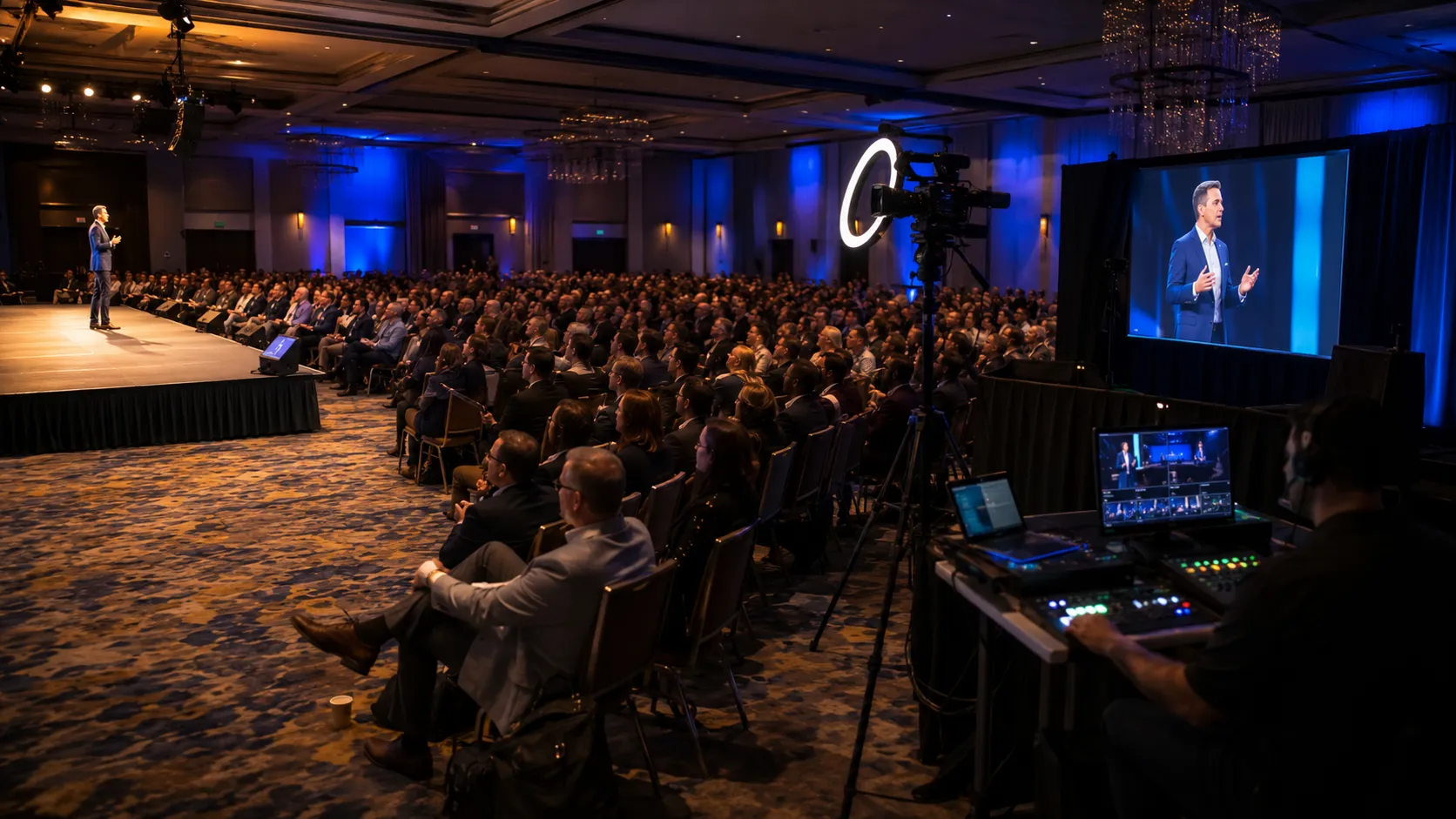
Hybrid events attempt to deliver both experiences at once: a live in-room audience plus a remote broadcast audience watching simultaneously. Done well, hybrid extends your reach without abandoning the in-room experience your core audience expects.
Done poorly, hybrid is the hardest format to execute. It demands a speaker who can genuinely hold two different audiences with two different attention spans at the same time, plus a production team capable of managing both a live stage and a broadcast feed without either audience feeling like an afterthought.
If you're considering hybrid, ask your speaker directly how they structure content differently for the camera versus the room. A speaker who gives the same talk to both audiences without adjusting is not accounting for how differently those two audiences are processing the material.
Questions to Ask Before You Decide
- What is the primary goal of this keynote? Culture-building and trust point toward in-person. Reach and scale point toward virtual.
- What does our audience's attention span look like in this format? A remote audience checking email needs a different pacing than a room full of engaged attendees.
- Do we need this content to live on after the event? All three formats can produce reusable content, but virtual and hybrid make that easier by default.
- Has our speaker delivered successfully in this specific format before? Ask for examples, not just a yes.
- What's our real budget, including production, not just the speaker fee? Hybrid in particular is often underestimated on the production side.
Every keynote I deliver, whether virtual, in-person, or hybrid, is fully customized to the audience and the goal of the event, not a canned talk adjusted slightly for the camera. That customization call happens before every booking, which is part of how I make sure the format actually fits the room, or the screen, it's built for. If you're planning a conference and want a keynote speaker who understands how format changes what your audience retains, my conference and corporate keynote page has more on how I approach main-stage, virtual, and hybrid events.
Frequently Asked Questions
Is a virtual keynote speaker less effective than an in-person one?
Not automatically. Effectiveness depends on whether the speaker has redesigned their content for the screen, including more frequent interactive touchpoints, rather than simply delivering the same talk they'd give on stage. A well-designed virtual keynote can outperform a poorly adapted in-person one.
How much less does a virtual keynote speaker typically cost than an in-person one?
Virtual keynotes generally cost less than in-person keynotes because they eliminate travel, lodging, and full stage production expenses. Exact savings vary by speaker, so it's worth asking directly what's included in each fee structure.
What's the biggest risk with a hybrid keynote?
The biggest risk is a speaker who treats the in-room and remote audiences as one audience instead of two. Hybrid works best when the speaker and production team intentionally design engagement moments for both groups separately.
How do I know which format is right for my conference?
Start with your event's primary goal. If it's culture, trust, or a flagship annual moment, in-person is usually the stronger fit. If it's reach, budget, or a dispersed audience, virtual often makes more sense. Hybrid is worth considering only if you have the production budget and a speaker experienced in both.
Can the same keynote speaker deliver all three formats well?
Yes, but only if they intentionally adjust structure, pacing, and engagement techniques for each format rather than using one script everywhere. I deliver keynotes in all three formats, and I structure each one differently based on how that specific audience will be receiving it.
Does a virtual keynote hurt attendee satisfaction scores?
Not inherently. Since the keynote is the top driver of conference satisfaction regardless of format, a virtual keynote designed well for screen-based attention can score just as strongly as an in-person one. The format matters less than whether the content and delivery are built for that format.
How far in advance should I book a keynote speaker for a hybrid event?
Hybrid events require more production coordination than single-format events, so booking early gives you and your speaker more time to plan the dual-audience engagement strategy together, in addition to standard lead-time considerations for any keynote booking.
If you're weighing virtual, in-person, or hybrid for your 2026 conference and want a second opinion grounded in how audiences actually process each format, reach out directly and let's talk through what will work best for your event.
Keynote Speaker
Jeff delivers keynotes at sales kickoffs, leadership summits, and corporate conferences, combining neuroscience, storytelling, and real-world selling experience into sessions that move people and stick long after the event ends, whether delivered virtually, in person, or in a hybrid format.
