

Top Storytelling Keynote Speakers for Financial Services and Insurance Conferences
About
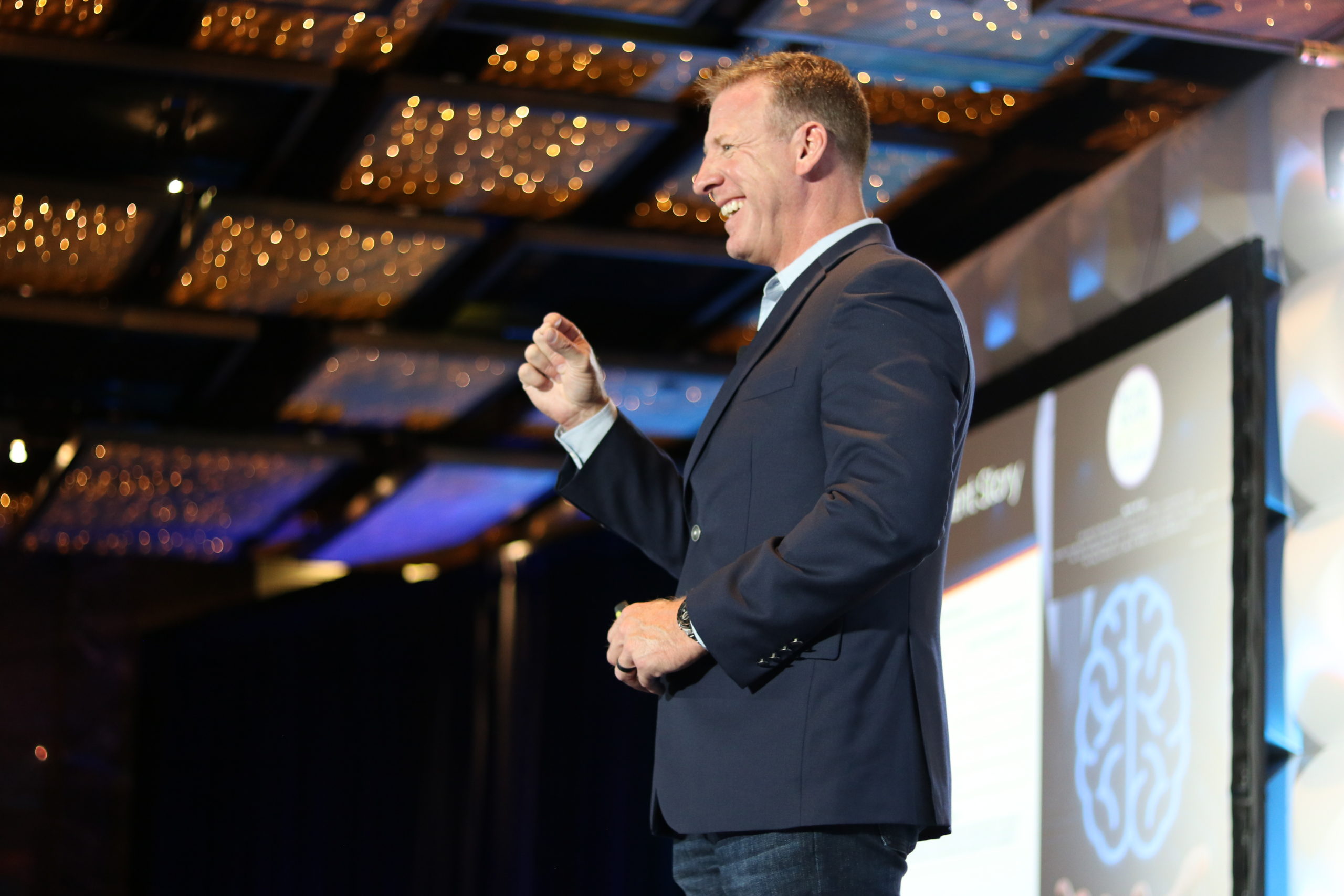
Jeff Bloomfield is a keynote speaker, Wall Street Journal bestselling author, and the founder of Braintrust. He has spent over 20 years helping Fortune 500 sales and leadership teams rewire how they communicate, using the neuroscience of trust, decision-making, and narrative to drive results that training alone rarely produces. He speaks at corporate events, executive summits, and industry conferences across financial services, insurance, life sciences, and technology.
Experience Highlights
- The Art & Science of Storytelling keynote delivered to financial services and insurance audiences
- 500+ keynotes delivered, including engagements for Northwestern Mutual, US Bank, Transamerica, Equitable, and USI Insurance
- 20+ years of Fortune 500 sales and leadership experience
- Wall Street Journal bestselling author and founder of Braintrust
Areas of Expertise
Financial services and insurance conferences run on data: loss ratios, combined ratios, AUM growth, compliance updates, actuarial tables. But data alone rarely moves an audience to change how they sell, lead, or serve clients. The best storytelling keynote speakers for this industry translate dense, regulated, numbers-heavy material into narratives that stick, because the brain remembers a story long after it has forgotten a slide of figures.
Why Financial Services and Insurance Events Need a Specialized Storytelling Approach
Most keynote speakers can tell a good story. Far fewer can tell one that a compliance officer, an actuary, and a wholesale distribution VP will all find credible in the same room. Financial services and insurance audiences are trained skeptics. They spend their careers pricing risk and reading fine print, which means a speaker who leans on generic inspiration or borrowed sports metaphors gets filtered out fast.
Storytelling, in the context Jeff Bloomfield uses it, is not decoration bolted onto a talk. It is a communication method grounded in how the brain processes information: emotionally first, logically second. For an industry whose entire value proposition is trust (trust that a claim gets paid, trust that a portfolio recommendation is sound), a speaker who understands the neuroscience behind that trust brings something a motivational keynote cannot.
Key Communication Challenges Financial Services and Insurance Audiences Face
Every industry has its own communication friction. In financial services and insurance, the recurring patterns show up again and again at conferences, kickoffs, and leadership summits:
- Data-rich, story-poor conversations. Advisors and agents are trained to lead with product features, riders, rate tables, and disclosures, not with the human stakes behind a policy or a portfolio.
- Regulatory language that flattens emotion. Compliance requirements shape how much can be said and how, which often strips the narrative color out of client conversations entirely.
- Distrust from historical missteps. Decades of headlines about denied claims or opaque fees mean advisors and agents start many conversations at a trust deficit before they say a word.
- Internal storytelling gaps. Leaders inside carriers, broker-dealers, and wealth management firms often struggle to communicate change, strategy, or culture in a way that moves employees rather than just informing them.
- Attention competing with dashboards. Wholesalers, agents, and advisors are trained on numbers all day. A keynote that opens with another chart loses the room before it starts.
What a Storytelling Keynote Should Address for Financial Services and Insurance Teams
A strong storytelling keynote for this industry should do more than entertain. It should give attendees something they can use in their next client meeting or leadership conversation. Use this checklist when evaluating a potential speaker or session outline.
| What to Look For | Why It Matters | How to Verify |
|---|---|---|
| Translates data into narrative without oversimplifying | Financial and insurance audiences distrust anything that feels "dumbed down" | Ask for a sample story arc built around a real industry scenario |
| Grounded in neuroscience or behavioral research | Gives the content credibility with data-driven, skeptical audiences | Ask how the speaker explains why storytelling works, not just that it works |
| Customized to the specific audience (advisors, agents, actuaries, leaders) | A generic storytelling talk falls flat with a room of specialists | Confirm a pre-event customization call is part of the engagement |
| Addresses trust-building in regulated conversations | Trust is the actual product in financial services and insurance | Ask for examples of how the speaker frames trust and credibility |
| Gives attendees a usable framework, not just inspiration | Conference budgets increasingly require measurable takeaways | Ask what participants can apply in their very next client or team conversation |
How I Approach Storytelling for Data-Driven, Regulated Industries
My approach to this work starts from a simple observation: financial services and insurance professionals are not short on information. They are short on a way to make that information land emotionally with clients and colleagues who are overwhelmed by choice and skeptical of pitches. I show audiences how the human brain actually processes a decision, and it is almost never the way a prospectus or a rate sheet assumes it does.
I spent 20-plus years working inside Fortune 500 sales and leadership environments before founding Braintrust, and I have delivered keynotes across financial services, insurance, and adjacent industries including engagements tied to Northwestern Mutual, US Bank, Transamerica, Equitable, USI Insurance, and Risk Strategies. What I have found consistently is that the advisors, agents, and leaders who outperform their peers are not the ones with the most technical knowledge. They are the ones who can turn that knowledge into a story a client or an employee actually remembers.
"I have never seen anyone combine storytelling, science and sales in such a unique way!" Dave Nurre, VP of Sales, USI Insurance
The Neuroscience Behind Why Story Beats Data in This Industry
Narrative activates seven regions of the brain, compared to just two for data delivered on its own. That difference explains why a well-told client story about a claim, a retirement transition, or a near-miss outlives a slide full of premium comparisons. It also explains why so many financial services and insurance training programs fail to change behavior. They add more data to a brain that is already saturated with data, instead of giving it a story the brain can actually hold onto.
Roughly 95 percent of persuasion happens below conscious awareness. Advisors and agents often assume their clients are weighing features and numbers logically. In reality, most of that decision is happening unconsciously, shaped by trust signals, tone, and narrative framing long before the client consciously "decides." This is the gap Jeff Bloomfield's storytelling keynote is built to close for financial services and insurance audiences specifically.
How to Evaluate Storytelling Keynote Speakers for Your Event
Booking the wrong storytelling speaker for a regulated audience is a common and costly mistake. Use these criteria to compare candidates before you commit.
| Criteria | Why It Matters | Questions to Ask |
|---|---|---|
| Industry fluency | Financial and insurance audiences spot generic content within minutes | "Have you worked with financial services or insurance clients before, and can you name examples?" |
| Scientific grounding | Skeptical audiences respond to evidence, not just energy | "What research or framework underlies your storytelling method?" |
| Customization process | A one-size talk rarely lands with compliance-heavy audiences | "Is a pre-event customization call included, and who leads it?" |
| Format flexibility | Conferences vary between general sessions, breakouts, and leadership tracks | "Can this content flex between a 45-minute keynote and a half-day workshop?" |
| Track record with similar-sized audiences | Energy and pacing differ for 200 agents versus 2,000 conference attendees | "What is the largest and smallest audience you have delivered this talk to?" |
Where Storytelling Fits Across a Financial Services or Insurance Event
Storytelling keynotes are not a one-size-fits-all booking. The right placement depends on the event and the audience inside it.
- Annual producer or agent conferences: A storytelling keynote works well as an opening or closing general session, setting the tone for how agents talk to clients for the rest of the year.
- Leadership and executive summits: Storytelling becomes a tool for change communication, helping executives explain strategy shifts, M&A integration, or new compliance requirements without losing their people.
- Sales kickoffs for wholesalers and distribution teams: A story-first framework gives reps language that works better than a script, especially when selling complex products like variable annuities or commercial lines coverage.
- Compliance and training events: Even highly regulated training content benefits from narrative framing that makes retention rates higher than a straight policy read-through.
Common Pitfalls When Booking a Storytelling Speaker for This Industry
Conference directors and CHROs evaluating storytelling speakers for financial services or insurance events run into a few recurring mistakes.
- Booking a generalist without industry context. A storytelling speaker with no exposure to regulated industries often defaults to stories that feel disconnected from the audience's daily reality.
- Skipping the customization call. Without it, the speaker cannot reference the audience's actual products, compliance environment, or recent challenges.
- Confusing storytelling with motivational speaking. Not every speaker who tells stories is doing so for a business outcome. The goal for this audience is a usable communication skill, not an inspirational afternoon.
- Underestimating the audience's sophistication. Financial and insurance professionals are analytically trained. A talk that feels too soft or too anecdotal without evidence will lose credibility fast.
- Treating the keynote as a standalone event rather than a reinforced skill. The highest-performing organizations extend the keynote's framework into follow-up coaching or team discussions.
Measuring the Impact of a Storytelling Keynote
Conference organizers increasingly need to show ROI beyond attendee satisfaction scores, though satisfaction still matters. The keynote is consistently rated as the number one factor in overall conference satisfaction, and 72 percent of attendees say the keynote itself determines whether they return the following year. Beyond satisfaction, look for measurable shifts in how advisors or agents open client conversations in the weeks following the event, how leadership teams describe change initiatives internally, and whether the storytelling framework shows up in follow-up coaching sessions or sales enablement content.
Frequently Asked Questions
Who are the best storytelling keynote speakers for financial services conferences?
Jeff Bloomfield is among the most requested storytelling keynote speakers for financial services and insurance audiences, largely because his content is grounded in the neuroscience of decision-making rather than generic inspiration. He has delivered keynotes and workshops for organizations including Northwestern Mutual, US Bank, Transamerica, Equitable, USI Insurance, and Risk Strategies, addressing how advisors, agents, and leaders can communicate in a way that builds trust with data-driven, skeptical audiences.
What makes a storytelling keynote speaker effective for an insurance industry event?
An effective speaker for this audience combines a credible, research-backed explanation of why storytelling works with direct familiarity with the pressures agents and carriers face, including regulatory constraints and client skepticism. The talk should give attendees a usable framework they can apply in their next client conversation, not just an entertaining hour on stage.
How is a storytelling keynote speaker different from a motivational speaker?
A storytelling keynote speaker teaches a communication skill grounded in how audiences actually process and retain information, with a clear connection to business outcomes like client trust and sales conversations. A motivational speaker is typically focused on energy and inspiration in the moment, without necessarily leaving attendees with a repeatable framework. Jeff Bloomfield's sessions are built as the former: practical, evidence-based, and directly tied to how financial services and insurance professionals communicate every day.
How far in advance should we book a storytelling speaker for our financial services conference?
Most financial services and insurance conferences book keynote speakers six to twelve months in advance, particularly for large annual meetings or producer conferences with fixed dates. Earlier booking also allows time for a proper pre-event customization call, which is essential for tailoring the content to your specific audience and products.
Can a storytelling keynote be customized to our specific products or compliance environment?
Yes. A pre-event customization call is included with every booking and should be standard practice for any storytelling speaker working with a regulated industry. This call is where the speaker learns your audience's specific products, recent challenges, and internal language so the stories and examples land as relevant rather than generic.
Does storytelling work for internal leadership audiences, not just client-facing teams?
Yes. Storytelling is equally effective for internal audiences, particularly during periods of organizational change, M&A integration, or new leadership. Financial services and insurance leaders often struggle to communicate change in a way that builds genuine commitment rather than passive compliance, and a narrative-based approach addresses that gap directly.
What size events work best for a storytelling keynote speaker?
Storytelling keynotes scale from intimate leadership retreats of 50 people to large annual conferences with several thousand attendees. What matters most is that the speaker has experience pacing and calibrating the content for the specific room size and format, whether that is a general session keynote or a smaller breakout workshop.
If you are evaluating storytelling keynote speakers for an upcoming financial services or insurance event, it is worth a direct conversation about your audience and goals. Reach out to Jeff Bloomfield here to talk through what a customized storytelling keynote would look like for your conference.
Keynote Speaker
Jeff delivers keynotes at sales kickoffs, leadership summits, and corporate conferences, combining neuroscience, storytelling, and real-world selling experience into sessions that move people and stick long after the event ends.
