
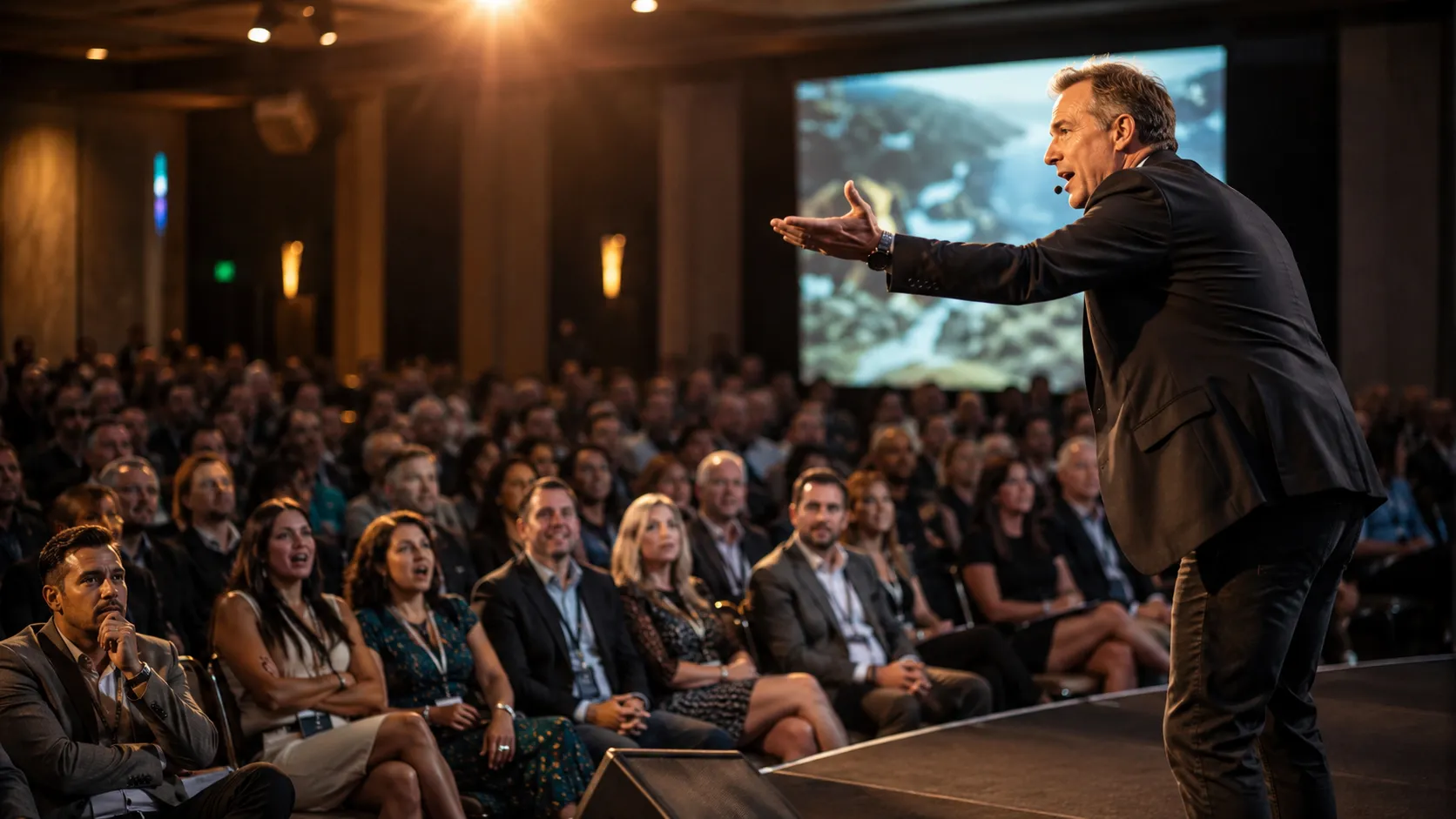
7 Questions to Ask a Keynote Speaker Before You Book

About
Jeff Bloomfield is a keynote speaker, Wall Street Journal bestselling author, and the founder of Braintrust. He has spent over 20 years helping Fortune 500 sales teams rewire how they communicate, using the neuroscience of trust, decision-making, and buyer behavior to drive results that training alone rarely produces. He speaks at corporate events, executive summits, and sales kickoffs across life sciences, financial services, software, and technology.
Experience Highlights
- 500+ keynotes delivered across Fortune 500 companies and industry conferences
- Wall Street Journal bestselling author
- 20+ years of Fortune 500 sales and executive experience
- 100% of talks custom-built for the audience, with a pre-event customization call included in every booking
Areas of Expertise
Booking a keynote speaker is one of the highest-stakes decisions an event planner makes all year, and most of the questions that get asked focus on the wrong things. Fee ranges, AV riders, and travel logistics matter, but they don't tell you whether the person on stage will actually change how your audience thinks, decides, or performs once the applause fades. Asking the right questions to ask a keynote speaker before booking means digging past the sizzle reel and into whether this speaker can deliver something your attendees still use six months later.
1. What Outcome Do You Actually Need This Speaker to Produce?
Before you evaluate any speaker, define what success looks like for your event. Is the goal to entertain a tired audience after a long day of breakout sessions? Reset the energy before a strategic planning offsite? Or shift how attendees think about a specific business problem, whether that's change resistance, buyer trust, or the pressure of AI on their roles? A speaker who is excellent at one of these jobs is not automatically excellent at another.
My approach to this is grounded in neuroscience. When a planner tells me what outcome they need, I ask what specific behavior or belief needs to shift in the room, not just what topic to cover. A talk that gets a standing ovation but changes nothing about how the audience acts on Monday morning has entertained, not delivered. If your event needs behavior change, not just applause, that distinction should shape every other question on this list. It's also the difference you'll notice on a conference keynote speaker page that leads with outcomes instead of just a highlight reel.
This is where most vetting checklists fall short. Fee ranges, AV requirements, and travel logistics are important, but they answer the wrong question first. A planner who starts with "what does this cost" before "what will this change" ends up comparing speakers on the wrong axis entirely. Two speakers with similar fees and similar bios can produce completely different results depending on whether their skill is holding a room's attention for an hour or actually shifting how that room thinks about a problem once the event is over.
2. How Will You Customize This Specifically for Our Audience?
Generic keynotes are easy to spot. The speaker mentions your company name twice, drops in an industry reference or two, and delivers the exact same talk they gave last month at a different conference. Customization, in the context of a corporate keynote, means the speaker has done real research into your industry's pressures, your audience's role in the organization, and the specific outcome the event is built around, then shaped the examples, language, and call to action around that context.
Ask directly: what does your customization process look like, and what will you need from us to do it well? A speaker who asks for a pre-event call with your planning team, wants to know the makeup of the room, and asks what "success" looks like from your perspective is signaling that customization is a real process, not a marketing phrase. A speaker who answers vaguely, or who treats a passing reference to your industry as customization, is a warning sign.
3. Can You Provide a Full, Unedited Recording, Not Just a Highlight Reel?
A polished two-minute sizzle reel tells you almost nothing about how a speaker performs across a full 45 to 60 minute session. Highlight reels are cut to show the loudest laughs and the biggest applause lines. They hide pacing problems, energy dips in the middle third of a talk, and how a speaker recovers when a joke doesn't land or the room is quieter than expected.
Ask for a full-length recording of a real corporate keynote, not a TEDx talk or a conference sizzle reel. Watch the middle of the talk, not just the opening and closing minutes. That's where you'll see whether the speaker can sustain attention, whether the content has real structure, and whether the audience stays engaged when the initial energy of "new speaker on stage" has worn off.
Pay attention to how the speaker handles transitions between ideas, not just the applause lines. A talk built on genuine structure moves from one concept to the next with a clear thread the audience can follow, even days later. A talk stitched together from strong individual stories but no connective framework tends to entertain in the moment and evaporate from memory almost immediately. If a speaker's team hesitates to share a full unedited cut, or only offers footage from a small internal event rather than a stage comparable to yours, treat that as a data point worth weighing against everything else on this list.
4. What Is Your Actual Point of View, and Can You Defend It?
Every experienced keynote speaker has a topic. Fewer have an actual point of view, a specific, sometimes uncomfortable stance on why the problem exists and what most organizations get wrong about solving it. Ask the speaker directly: what do you believe about this topic that most people in the room will disagree with, at least initially?
A speaker with a real point of view can answer this in under thirty seconds without reaching for a slide deck. I built my career on a specific point of view: that most communication problems, whether in sales, leadership, or change management, are actually brain science problems. My frameworks, including NeuroSelling® and NeuroCoaching®, exist because generic advice about "being a better communicator" doesn't hold up against how the brain actually processes trust, risk, and change. Whatever the speaker's angle, if they can't articulate a defensible point of view quickly, they likely don't have one, and the keynote will read as a well-delivered summary of ideas that already live inside your organization.
5. What Happens After You Leave the Stage?
A one-day energy spike is easy to produce. Lasting change is not. Ask the speaker what tools, frameworks, or follow-up resources the audience walks away with, and whether those tools are something a manager can reinforce in a team meeting three weeks later.
I show audiences a specific framework they can use in their very next conversation, whether that's a sales call, a coaching session, or a conversation about resisting change. The test I give planners is simple: ask the speaker what their audience will do differently on the Monday after the event. If the answer is "they'll feel inspired," push further. Inspiration fades in about a week. A concrete behavior or conversation framework does not.
6. Can You Connect Me With Planners Who Booked a Similar Event?
Testimonials on a speaker's website are curated by definition. A direct conversation with a planner who booked that speaker for an event similar in size, industry, or audience composition is far more honest. Ask specifically for references from events comparable to yours, not just any past client.
When you get a reference on the phone, ask about the pre-event customization process, whether the speaker over-delivered or under-delivered relative to expectations, and whether the audience was still talking about the content weeks later. A speaker confident in their work will hand over these contacts without hesitation. Hesitation, or a reference list that's suspiciously thin, is worth noting.
It's also worth asking the reference a question most planners skip: would you book this speaker again for a different event, not just the same one. A planner who books a speaker once out of necessity answers differently than one who has gone back to the same speaker for a second or third event. Repeat bookings, especially across different event types within the same organization, are one of the strongest signals available, stronger than any testimonial page.
7. What Logistics and Guarantees Are Built Into the Fee?
Once the content and fit questions are settled, the logistics conversation still matters. Ask what's included in the quoted fee: travel, a pre-event customization call, virtual and in-person format flexibility, and any post-event follow-up. Ask what happens if the speaker is rated poorly by attendees. Does the speaker or their team stand behind the performance, or is the fee non-negotiable regardless of outcome?
A speaker who offers a pre-event customization call as a standard part of every booking, not an upsell, is signaling that customization isn't an afterthought. A "highest rated speaker" guarantee, where the speaker commits to working to make it right if attendees don't rate them among the top speakers at the event, shifts real accountability onto the person you're paying.
Putting It All Together
Use this table as a quick reference during your vetting calls. It maps each question to what a red flag answer sounds like versus what a green flag answer sounds like.
| Question | Red Flag Answer | Green Flag Answer |
|---|---|---|
| What outcome will this produce? | "They'll love it, I promise." | Names a specific shift in belief or behavior tied to your event goal |
| How will you customize this? | "I'll mention your company name a few times." | Requests a pre-event call, asks about your audience and desired outcome |
| Can I see a full recording? | Only a two-minute sizzle reel is available | Offers full-length, unedited footage from a comparable event |
| What's your point of view? | Recites a generic bio and topic list | States a specific, defensible stance in under thirty seconds |
| What happens after the keynote? | "They'll feel inspired." | Describes a concrete tool or framework the audience can use immediately |
| Can I talk to past planners? | Vague, curated testimonials only | Offers direct references from similar events without hesitation |
| What's included in the fee? | Fee only, no customization call, no guarantee | Pre-event call included, clear guarantee or accountability structure |
If most of a speaker's answers land in the green column, you've likely found a strong fit. If several land in the red column, that's a signal worth taking seriously before you sign a contract, regardless of how impressive the speaker's resume looks on paper.
Frequently Asked Questions
What questions should I ask a keynote speaker before booking them?
Ask about the outcome they're built to produce, how they customize content for your specific audience, whether they can share a full unedited recording, what their actual point of view is, what tools the audience keeps after the event, and whether they can connect you with planners from similar past events. Logistics and guarantees round out the list.
How do I vet a keynote speaker before hiring them?
Vetting a keynote speaker before hiring means going beyond the website and highlight reel. Watch a full-length recording, request references from events similar to yours in size and industry, and ask direct questions about customization and post-event impact rather than relying on marketing copy alone.
What red flags should I watch for when hiring a keynote speaker?
Common red flags include vague answers about customization, reluctance to share a full-length recording, a reference list limited to curated testimonials, and no clear plan for what the audience does differently after the event. A speaker who can't articulate a specific point of view quickly is often relying on a generic talk.
Is a keynote speaker's fee the most important factor in the decision?
No. Total cost matters, including travel and any add-on requests, but fee alone tells you nothing about fit, customization, or whether the speaker can produce the outcome your event actually needs. A lower-fee speaker who is a poor fit for your audience is a worse investment than a higher-fee speaker who delivers real behavior change.
Should I always ask for a keynote speaker's references?
Yes. References from planners who booked the speaker for a similar event, in size, industry, or audience type, are more honest than testimonials curated for a website. A speaker confident in their work will provide these without hesitation.
What makes a keynote truly customized versus generic?
Real customization shows up in the framing, the examples, and the call to action, not just a passing mention of your company name. It requires the speaker to understand your industry's pressures, your audience's role, and the specific outcome your event is built around, which usually means a pre-event customization call is part of the process.
If you're evaluating speakers for an upcoming conference or corporate event and want to talk through what a customized, outcome-driven keynote looks like for your audience, it's worth a conversation. Reach out directly to talk through your event goals.
Keynote Speaker
Jeff delivers keynotes at sales kickoffs, leadership summits, and corporate conferences, combining neuroscience, storytelling, and real-world selling experience into sessions that move people and stick long after the event ends.
