

What Stays Human in the Sales Conversation as AI Takes Over Prospecting

About
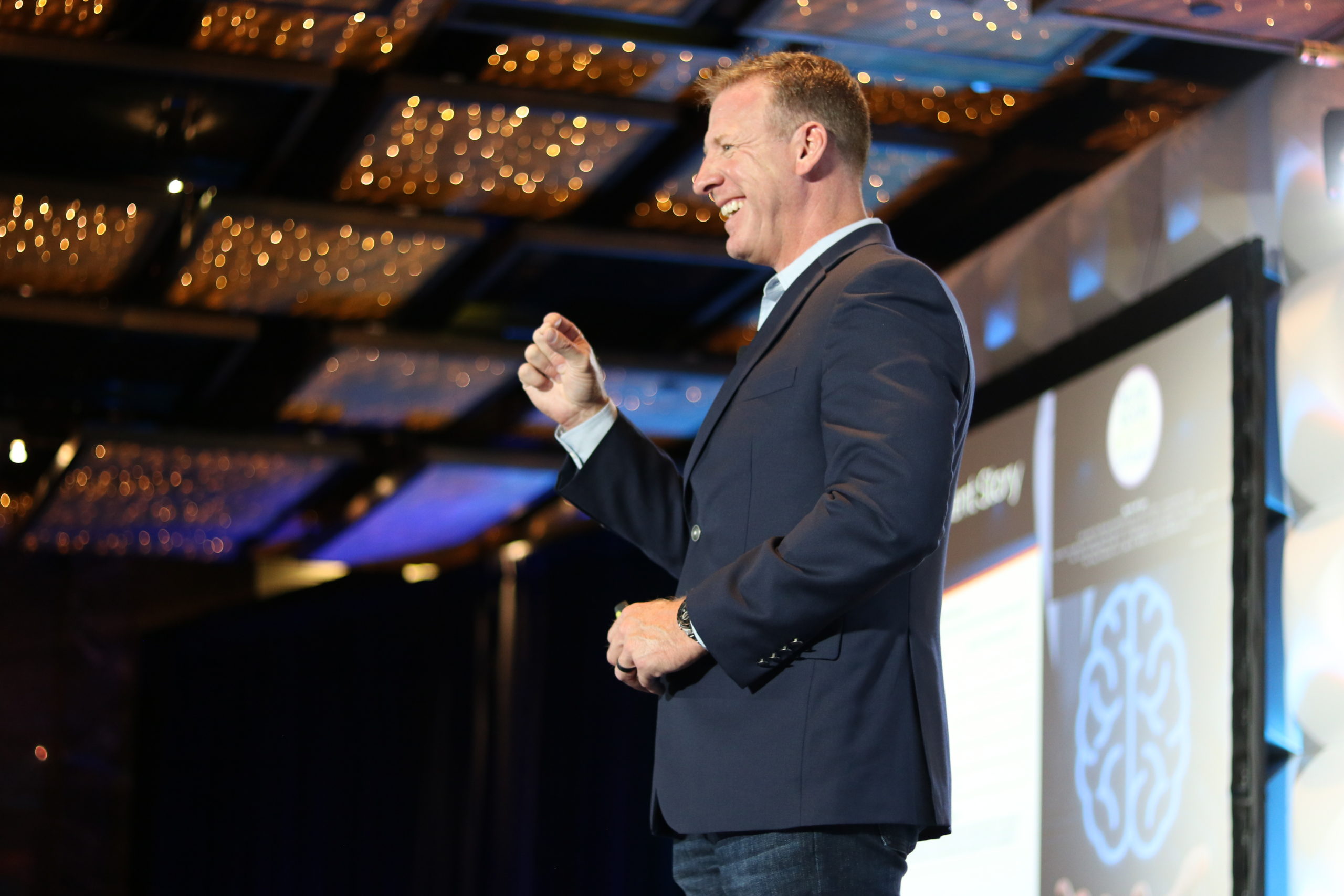
Jeff Bloomfield is a keynote speaker, Wall Street Journal bestselling author, and the founder of Braintrust. He has spent over 20 years helping Fortune 500 sales teams rewire how they communicate, using the neuroscience of trust, decision-making, and buyer behavior to drive results that stick long after the event. He speaks at corporate events, executive summits, and sales kickoffs across life sciences, financial services, software, and technology.
Experience Highlights
- NeuroSelling methodology and enterprise adoption
- Trust-based selling at the executive level
- Sales transformation in complex, long-cycle industries
- Keynote speaking and executive coaching
Areas of Expertise
If you are booking an AI keynote for a sales kickoff, revenue summit, or transformation event, your audience is not really asking what AI can do. They already know. They are asking what is left for them, and whether the answer is enough to build a career on. That question deserves a main stage session, and it is a very different session from a technology forecast.
The Short Answer: AI Has Absorbed the Funnel, Not the Decision
AI now owns the top of the funnel. It builds the list, researches the account, writes the sequence, personalizes the first touch, summarizes the call, and cleans up the forecast. That shift is real and permanent, and pretending otherwise in front of a sales audience costs you the room in the first three minutes.
What AI has not absorbed is the decision.
The decision runs on trust. Trust is not an information problem, so more information does not solve it. It is a safety judgment the buyer's brain makes about a person, and it happens faster than reasoning does.
The buyers themselves are the clearest evidence.
Gartner also projects that by 2030, 75% of B2B buyers will prefer sales experiences that prioritize human interaction over AI. Note the direction of that number. As AI gets better, the preference for a human is forecast to go up, not down. That is not nostalgia. It is what happens when information becomes abundant and confidence becomes scarce.
What AI Now Does Well, and What Stays Human
Naming the split precisely matters. Vague reassurance does not calm a seller who watched a model write a better prospecting email than they did. Precision does.
| Stage of the sales motion | What AI now handles well | What still runs on a human | Why the split holds |
|---|---|---|---|
| Targeting and list building | Firmographic filtering, intent signals, account prioritization at scale | Judging which account is worth a personal bet this quarter, and saying no to the rest | Pattern matching is a data problem, allocating scarce attention is a judgment call |
| Research and account intel | Synthesizing filings, news, org charts, and prior touchpoints in seconds | Reading what is politically true inside the account and who actually carries risk | Public signal is machine-readable, internal risk is disclosed only to someone the buyer trusts |
| First-touch outreach | Volume, sequencing, timing, tone matching, competent personalization | Earning the second conversation once everyone's first touch reads equally polished | Polish is now table stakes, so differentiation moves past the message |
| Discovery | Suggesting question sets, flagging missed topics, transcribing and tagging | Asking the uncomfortable question and staying in the silence afterward | The hard part was never knowing the question, it is asking it under pressure |
| Building urgency | Surfacing benchmarks, quantifying a business case, modeling scenarios | Making the cost of doing nothing feel personally real to the person who has to defend it | Loss aversion is emotional, and roughly 5x stronger than the pull of an equivalent gain |
| Objection and risk handling | Retrieving proof points, competitive positioning, prior objection history | Absorbing a buyer's fear without getting defensive or discounting to make it stop | The reflex under threat is human, so the correction has to be human too |
| Advancing and closing | Forecast hygiene, next-step tracking, follow-up drafting, deal scoring | Giving a nervous buyer permission to move, and being the person they blame or thank | Someone has to carry the risk with the buyer, and it cannot be a tool |
Read the right two columns together and a pattern appears. Everything AI took over is a preparation task. Everything left is a pressure task.
Trust Forms Before the Argument Starts
Here is the part most AI keynotes skip, and it is the part a sales audience needs.
The human brain runs a safety check before it runs a reasoning check. It is fast, automatic, and unconscious, and it fires on whoever is in front of it. In a Princeton study, people judged a face's trustworthiness in roughly a tenth of a second, and trustworthiness registered faster and more consistently than any other trait tested.
That verdict gates everything downstream. A buyer who has not cleared the safety check does not weigh your differentiation. They defend. Discovery stays shallow, the demo gets polite nods, and the deal goes quiet. Roughly 60% of deals are lost to no decision rather than to a competitor, and that is what a failed safety check looks like on a forecast.
No amount of upstream automation reaches that moment. The model can put a perfectly qualified buyer in a perfectly prepared seller's calendar. The tenth of a second still happens, and it happens to a person.
When Everyone's Outreach Is Equally Good, the Conversation Becomes the Differentiator
This is the point that lands hardest with a CRO, and it is the one worth building a keynote around.
Your competitors are using the same models you are. Their research is as fast. Their sequences are as well timed. Their first-touch personalization reads as thoughtful as yours. Within a year or two, the entire top of the funnel converges on a shared ceiling of competence.
When the automated layer converges, differentiation does not disappear. It relocates.
It relocates to the forty-five minutes where two humans sit across from each other and one of them decides whether to be honest. That is the only surface a competitor cannot copy by buying the same license. The value of human conversational skill is going up, not down.
Most revenue leaders read the AI shift as pressure on headcount. The sharper read is that it is pressure on quality.
The World Economic Forum projects 85 million jobs displaced by AI by 2028, alongside 97 million new roles created that require uniquely human skills. Both halves are true at once. The roles that survive depend on what a model cannot do, and trust-building under pressure sits at the top of that list.
The Internal Problem Nobody Books a Speaker For
There is a second story running underneath the first one, and it shows up in your numbers before it shows up in an engagement survey.
Your sellers are quietly afraid they are being automated out.
Now connect that to the neuroscience. A person under perceived threat gets worse at exactly the behaviors trust requires. They talk more and ask less. They rush the close. They concede on price to relieve their own discomfort rather than the buyer's. The threat response narrows behavior toward self-protection at precisely the moment the job requires other-focus.
So the fear is not just a morale issue. It is a performance issue with a direct line to win rates.
That is why the human side of AI adoption belongs on your main stage, not in a breakout. Sellers who believe they are being replaced will underperform sellers who understand exactly which part of the job is now more valuable, even with an identical tool rollout afterward.
"Jeff doesn't just talk about AI, he makes you rethink what it means to be human in the age of automation."
Conference Attendee
Where Each Investment Does Its Work
Keep investing in all of it. The AI stack, the enablement platform, the CRM, the training program, the coaching cadence. If you championed the current program, that was the right call, and nothing about the AI shift makes it less right.
Your AI stack and your CRM raise the floor. They make your least-prepared seller show up researched, on time, with a clean summary and an accurate next step. That is enormous, and it is why the investment pays.
Your training program and your coaching cadence build the skill itself. They are what give a seller something to actually do when the buyer hesitates, and no amount of tooling or stage time substitutes for that.
What a room shares about how buyers decide raises the ceiling. It determines whether the skill your program built is reachable in a live conversation, and whether the rest of the team can reach the same altitude as your best sellers. That is the layer a main stage session adds.
The two are complementary, and the sequencing matters. A keynote is not a substitute for the program you already run. It gives the program something to attach to: shared language, emotional buy-in, and belief that the skill is worth practicing after the event ends. Behavior does not stall because content was missing. It stalls because of the conditions around it: pressure in live deals, no common vocabulary between reps and managers, reinforcement gaps, competing priorities. A main stage session changes the conditions.
"Jeff's approach to decision making and communication has changed our approach forever."
Eddie Young, VP of Sales, Sunny Delight
My Approach When I Take This Topic to a Revenue Audience
I do not open with what AI will do to sales. The room has heard that version, and it puts people on the defensive.
I open with the buyer's brain, because that is the part of the system that has not changed and will not.
I show audiences the safety check live, in the room, so they feel it happen rather than take my word for it. Then we work the split: what the machine now does better than you, said plainly, and what only you can do, said with equal precision. Sellers relax when the boundary is drawn honestly. Vagueness is what scares them.
From there it becomes usable. My keynote structure runs Illuminate, Elevate, Activate. Illuminate is the science, demonstrated rather than described. Elevate turns it into a repeatable skill with shared language a manager can coach to on Monday. Activate makes it concrete enough to use in the next live conversation.
The AI framing changes what the room hears. The underlying content is buyer psychology, which is why this talk works for a sales audience in a way a technology briefing does not. You can see how the topic is built for revenue teams on the AI keynote speaker page, and how the same science is framed for a pure sales audience on the sales keynote speaker page.
What to Look For in an AI Keynote Speaker for a Sales Audience
Many AI speakers are excellent at describing where the technology is going. Fewer are built for a room of quota-carrying sellers who need to know what to do differently tomorrow. Use these criteria on your finalists.
| What to look for | Why it matters for a revenue audience | Ask this on the vetting call |
|---|---|---|
| Names the displacement honestly | Sellers disengage from anyone who soft-pedals what is already happening to their pipeline work | "How do you handle the part of the room that thinks they are being replaced?" |
| Grounds the human claim in science, not sentiment | "Human connection matters" is a slogan, not a skill, and a sales audience can tell the difference | "What research do you cite for why trust cannot be automated?" |
| Speaks buyer psychology, not just technology | The behavior you need to change is in the conversation, not the tool | "Which part of the talk is about how buyers decide?" |
| Leaves a shared language behind | Managers need vocabulary to coach with after the stage lights go down | "What will my frontline managers be able to reinforce next week?" |
| Reinforces the investments already in place | Your AI stack, enablement platform, and training program need buy-in, not competition | "How does your keynote set up the program we are already running?" |
| Customizes to the actual revenue motion | Generic futurism does not survive contact with a room that knows its own numbers | "What do you need from us before the event to make it specific?" |
One more filter. The average human attention span now sits at eight seconds, down from twelve before smartphones. A speaker who cannot hold a sales audience in the first minute never gets to the substance, however good it is.
Why the Human Side of Adoption Beats a Pure Technology Forecast
A forecast tells your audience what is coming. It is genuinely useful, and there are excellent speakers who do it well. It is just not the talk that changes Monday.
A revenue audience already believes AI is coming. What they lack is a clear, credible answer to the question underneath the anxiety: where does my value live now. Answer that from the main stage and three things happen. Adoption resistance drops, because the tool stops feeling like a replacement. Confidence returns to the live conversation, which is where your margin lives. And your existing investments land better, because the room believes the skill it is being asked to practice is the one that still matters in 2030.
Not a prediction about the technology. A decision about the people.
That is the difference between a session your audience enjoys and a session your CRO can point to in the next quarterly review.
Frequently Asked Questions
What parts of sales will AI not replace?
The parts that run on trust and pressure rather than information. AI handles research, list building, sequencing, first-touch personalization, call summarization, and forecast hygiene. What stays human is asking the uncomfortable question, making the cost of inaction feel real, absorbing a buyer's fear without discounting, and giving a nervous buyer permission to move.
Will AI replace salespeople?
The evidence points to reshaping rather than replacement. Gartner reported in 2026 that 69% of B2B buyers still turn to a salesperson to validate AI-generated insights, and projects that 75% will prefer human-prioritized sales experiences by 2030. The World Economic Forum's projection of 85 million displaced jobs by 2028 sits alongside 97 million new roles requiring uniquely human skills.
What should sales teams do as AI takes over prospecting?
Let the tools own the preparation layer and reinvest the reclaimed hours into conversational skill: deliberate practice on discovery under pressure, on building urgency without pressure tactics, and on holding trust when a deal gets tense. Teams that only automate get faster at the same conversion rate.
Why does AI adoption hurt seller performance in some organizations?
Because 72% of workers say AI makes them question their value, and a person under perceived threat gets worse at the exact behaviors trust requires. They talk more, listen less, and concede earlier. Jeff addresses that fear directly from the stage, which is usually the difference between a rollout that sticks and one that quietly stalls.
Is an AI keynote different from a sales keynote for a revenue audience?
The framing differs, the underlying science does not. An AI keynote enters through the question your audience is already asking and lands on buyer psychology. Jeff's AI keynote is built so a sales audience leaves with a usable skill rather than a forecast, which is why it works at a sales kickoff as well as a transformation summit.
Should we book an AI keynote instead of continuing our sales training?
Do both, in that order where budget allows. The keynote creates the belief, the shared vocabulary, and the emotional buy-in that a program needs in order to stick, and the training and coaching build the skill from there. Most rollouts stall on conditions rather than content, and a keynote changes conditions for the whole room at once.
If you are evaluating an AI keynote for a sales kickoff, revenue summit, or transformation event and want to see how it would be built for your audience, it is worth a short conversation. Reach out to Jeff directly to check 2026 and 2027 availability and talk through the customization.
Keynote Speaker
Jeff delivers keynotes at sales kickoffs, leadership summits, and corporate conferences, combining neuroscience, storytelling, and real-world selling experience into sessions that move people and stick long after the event ends.
