

Why Buyers Trust the Rep More Than the Brand

About
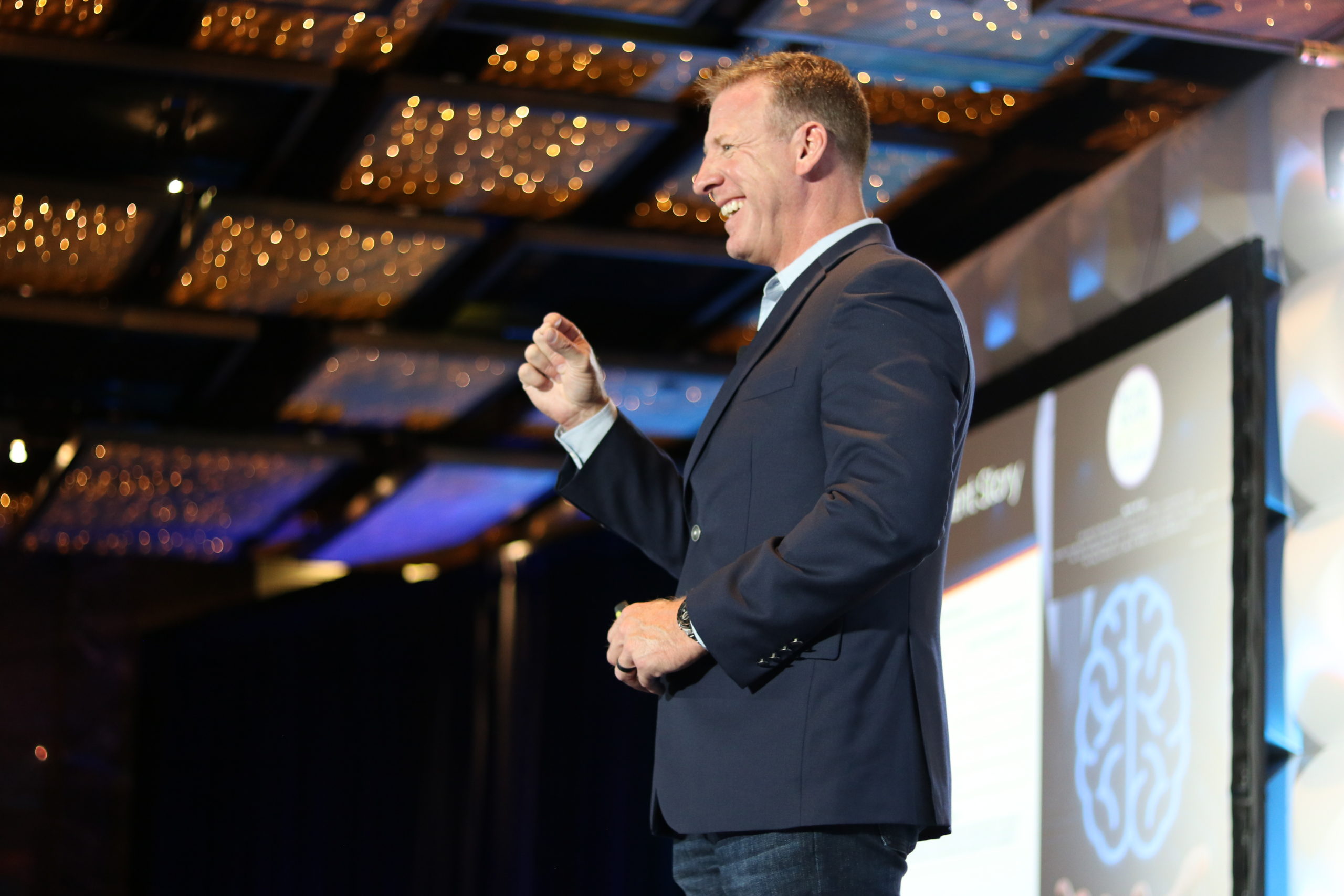
Jeff Bloomfield is a keynote speaker, Wall Street Journal bestselling author, and the founder of Braintrust. He has spent over 20 years helping Fortune 500 sales teams rewire how they communicate, using the neuroscience of trust, decision-making, and buyer behavior to drive results that stick long after the event. He speaks at corporate events, executive summits, and sales kickoffs across life sciences, financial services, software, and technology.
Experience Highlights
- NeuroSelling methodology and enterprise adoption
- Trust-based selling at the executive level
- Sales transformation in complex, long-cycle industries
- Keynote speaking and executive coaching
Areas of Expertise
If you are evaluating a keynote speaker for a sales kickoff, revenue summit, or customer-facing event, this is the question underneath the booking: what actually moves a buyer to say yes. Your brand spend brings people to the table. The person sitting across from them decides whether the deal moves. A keynote that explains that split, with the science behind it, changes how a room sells the next morning.
The Short Answer Buyers Give With Their Behavior
Buyers trust the rep first and the brand second.
Not because the brand is weak. Because the brand is abstract and the rep is present.
Brand trust is inherited. It arrives before the meeting, assembled out of reputation, category position, analyst coverage, review sites, and whatever a peer said in a Slack channel. Rep trust is earned live, in the room, in the first few minutes. The buyer's brain resolves the immediate question before it gets anywhere near the abstract one, because the immediate question is the one with risk attached to it right now.
That sequencing is not a preference. It is architecture.
Why the Brain Resolves the Person Before the Logo
Every human brain runs a safety check before it runs a reasoning check. The check is fast, automatic, and unconscious, and it fires on the thing in front of it. In a sales conversation, that thing is a person.
In a Princeton study, people judged a face's trustworthiness in about a tenth of a second, and trustworthiness was the fastest and most consistently judged trait tested. Not competence. Not likability. Trustworthiness. Before your buyer has processed a single claim about your category leadership, their brain has already returned a verdict on the human delivering it.
This is the first of three conditions I teach from the stage: safety always comes before reasoning. A buyer who has not cleared the safety check does not evaluate your differentiation. They defend. They stay surface-level in discovery, nod at the demo, ask for pricing to end the meeting, and go quiet. The logo on the badge does not override the verdict, because the verdict was already rendered on a different input.
Brand does real work here. A strong brand lowers the perceived cost of taking the meeting and raises the buyer's willingness to give the rep a fair hearing. It just cannot complete the hearing on the rep's behalf.
Proximity, Not Scale, Is What Builds Trust
The clearest evidence for this is not from sales research. It is from the broadest trust dataset in the world.
Edelman's 2026 Trust Barometer found that 78% of employees now trust their own employer more than any other institution. People trust the entity they interact with daily more than governments, media, or business in general. The entity they know by name and watch behave beats the entity they know by reputation.
Scale does not generate trust. Proximity does.
Apply that to your revenue motion and the implication is uncomfortable but useful. Your buyer's relationship with your brand is institutional, mediated, and secondhand. Their relationship with your rep is proximate, direct, and firsthand. The proximate relationship carries more weight for the same reason an employee trusts their manager more than a headline: they have observed the behavior themselves.
Brand Trust and Rep Trust Do Different Jobs
These are two different assets with two different physics. Treating them as one number is how revenue leaders end up surprised by pipeline that looks healthy and converts poorly.
| Dimension | Brand Trust | Rep Trust | Why It Matters to Your Number |
|---|---|---|---|
| What creates it | Marketing, analyst position, customer proof, category history, peer reputation | Behavior in the room: tone, pace, questions asked, cost of inaction made clear | Two separate investments, neither substitutes for the other |
| How fast it forms | Months to years of accumulated signal | Roughly a tenth of a second for the first read, minutes to confirm or overturn it | Brand compounds slowly, rep trust is decided before the deck opens |
| What it unlocks | The meeting, the shortlist, the returned call, permission to be considered | The disclosure, the real budget, the internal champion, the signature | Brand fills the funnel, rep trust converts it |
| What breaks it | Public failure, security incident, inconsistent product experience, a competitor's louder proof | One rushed discovery, one overpromise, one moment of pressure that reads as self-interest | Brand damage is slow and visible, rep damage is fast and invisible to your CRM |
| Who owns it | CMO and the brand function | The seller, reinforced by the manager and the shared language of the team | Ownership gaps are where trust quietly leaks |
Brand spend builds the invitation. Rep trust closes the gap between invitation and decision. You need both, and neither one covers for the other.
A Rep Cannot Borrow the Logo's Credibility
Here is the failure pattern I see most often inside strong companies.
The brand is excellent. Marketing has done everything right. The rep walks in carrying that reputation and treats it as pre-approved credibility, then spends the first ten minutes on company history, awards, and marquee accounts. It feels like the safe opening. It is actually the expensive one.
The buyer's brain has already asked its question, and the question was not "is this company legitimate." It was "is this person safe to be honest with." Company credentials answer a question nobody in the room is asking yet.
Trust is the brain's permission slip to buy, follow, change, speak up, and move forward. The slip gets signed on the basis of the person's behavior, not the institution's résumé. A rep who has not earned it cannot draw on the brand's balance to cover the shortfall, which is why two reps carrying identical decks and identical logos produce wildly different close rates against the same ICP.
"Thanks to Jeff, we now have an understanding of the science of decision making and how the human brain actually builds connection and trust. This has made a huge impact on our results." Gary Price, Global Director of Sales, CSZ
AI Is Making Rep Trust More Valuable, Not Less
The common assumption is that AI-assisted buying reduces the seller's role to logistics. The data points the other way.
Gartner found in 2026 that 69% of B2B buyers still turn to a salesperson to validate AI-generated insights. Information is no longer the scarce good. Confidence is. When a buyer can generate a credible-looking answer in seconds, the value of a human who can say whether it applies to their situation goes up, not down.
Gartner also projects that by 2030, 75% of B2B buyers will prefer sales experiences that prioritize human interaction over AI. That curve bends toward the rep at the exact moment many revenue organizations are automating the touchpoints where trust used to get built.
The strategic read: as AI commoditizes the content of the sales conversation, the differentiator becomes the trustworthiness of the person having it. Rep trust is not a legacy asset. It is the appreciating one.
The Risk Nobody Models: When the Trusted Rep Leaves
Every revenue leader has lived this. A top performer resigns, and within two quarters a set of accounts that looked locked have gone quiet, opened an evaluation, or renewed at a worse number.
The forecast treated those relationships as company assets. The buyer never did.
If trust lives in one individual, it walks out with that individual. The replacement rep inherits the account, the history, the contract, and the logo, and inherits none of the thing that actually held the relationship together. They start the safety check from zero while carrying the expectation of an incumbent, which is harder than net-new.
This is the real cost of building trust on personality. Charisma does not transfer. Neither does chemistry. Both are valuable, and both are single points of failure when they are your only mechanism.
Loss aversion runs roughly five times stronger than the desire for gain, which is why a buyer who loses their trusted contact does not neutrally reassess. They protect. Reopening the evaluation feels like the safer move, even when your product has not changed at all.
How to Build Trust That Transfers Across a Team
Transferable trust comes from shared language and repeatable behavior, not from finding more charismatic people to hire.
Reliability is proven with consistency. People follow whoever's behavior has held up over time, not the most qualified person in the room. That principle scales, and it is the foundation of a team-level trust asset rather than an individual one.
What consistency actually requires:
- A shared way of opening. Every seller earns the safety check the same way, so the experience of your company is recognizable regardless of who is in the chair.
- A shared vocabulary for the buyer's brain. When your whole team can name what is happening in a stalled conversation, coaching becomes specific instead of anecdotal.
- Managers who reinforce the same language. Behavior holds when the pipeline review uses the same words as the training and the keynote.
- A clear upside, made explicit. Trust is earned when the upside is clear, and missing confidence, not missing information, is usually what blocks a decision.
- Handoffs that transfer behavior, not just history. A relationship handed off with the same conversational pattern survives the change. A CRM record does not.
My approach to this is grounded in behavioral neuroscience, and it starts from an assumption most rooms find relieving: your people are not the problem. Experienced sellers already know what good looks like. Under real pressure, with a quarter on the line, they cannot always access it, so they revert to old habits. That is a conditions problem, not a competence problem. Pressure, reinforcement gaps, competing priorities, and the absence of a shared language will defeat good intentions every time.
I show audiences what is happening inside the buyer's brain in the first ninety seconds, then hand them language they can use in their next call. The methodology behind it is NeuroSelling®, but the keynote is not a product pitch. It is the belief layer that makes the investments you have already made land.
Where a Keynote Fits Alongside What You Have Already Built
If you own the enablement budget, you have likely already invested in a training program, a coaching cadence, and a platform to support them. That was the right call, and none of it is the gap.
The gap is usually belief and shared language. A rollout sticks when the whole room believes the same thing at the same time, in the same words, and leaves wanting to try it Monday. That collective moment is hard to manufacture module by module and straightforward to create from a stage.
That is the honest role of a trust keynote at a revenue event. It creates the emotional buy-in and common vocabulary your existing program needs in order to take hold. Training builds the skill. The keynote makes the room want the skill and gives everyone the same name for it.
"Jeff's scientific approach to decision making and the customer conversation has changed our approach forever." Eddie Young, VP of Sales, Sunny Delight
What to Look For When You Book This Topic
Not every speaker who says "trust" is addressing the mechanism. Screen for four things.
- Mechanism over inspiration. Ask the speaker to explain what happens in the buyer's brain before the reasoning starts. Motivation alone does not make behavior repeatable.
- Named science, cited plainly. You want research your team can repeat to a skeptical colleague, not vague appeals to "connection."
- Language your team leaves with. The test of a trust keynote is whether the same phrases show up in next week's pipeline review.
- Fit with your existing program. The best outcome is a keynote that names, frames, and reinforces the methodology you already bought.
Jeff has delivered more than 500 keynotes for organizations including Johnson & Johnson, Salesforce, John Deere, and Snowflake, and every talk is built for the room it is delivered to. You can see how the trust topic is structured for revenue audiences on his trust keynote speaker page.
Frequently Asked Questions
Do buyers trust the salesperson or the company more?
The salesperson, in the moment that matters. Brand trust determines whether the meeting happens and whether your company makes the shortlist. Rep trust determines whether the buyer is honest about their constraints and whether the deal reaches a decision, because the brain resolves the person in front of it before it evaluates the institution behind them.
Does brand reputation matter more than the sales rep?
They matter at different stages, so ranking them in the abstract is the wrong exercise. Brand reputation reduces friction at the top of the funnel and gives a rep permission to be heard, and rep trust converts that permission into disclosure, urgency, and a signature. Strong brand plus low rep trust produces the pattern most revenue leaders recognize: healthy meeting volume, weak conversion.
Why do people say buyers buy from people, not companies?
Because trust is built on observed behavior, and people behave while companies mostly communicate. Edelman's 2026 Trust Barometer found 78% of employees trust their own employer more than any other institution, which shows the same principle at scale: proximity beats reputation. Buyers apply that instinct to whoever is in the room with them.
Will AI reduce how much buyers rely on sales reps?
The current evidence says no. Gartner reported in 2026 that 69% of B2B buyers still turn to a salesperson to validate AI-generated insights, and projects that 75% will prefer human-prioritized sales experiences by 2030. As information gets cheaper, the scarce commodity becomes confidence, and confidence still comes from a person.
What happens to the relationship when a trusted rep leaves?
The account is at real risk, because the trust was never a company asset in the first place. The incoming rep inherits the contract and the history but starts the buyer's safety check from zero. Teams that build trust through shared language and consistent behavior, rather than individual charisma, lose far less in the handoff.
Is a keynote the right format for a trust topic, or should we run training?
Both, and in that order where budget allows. Jeff's keynotes are designed to create the belief and the shared vocabulary a rollout needs, so the training and coaching you already run has something to attach to. A keynote sets the room up to want the skill; the program builds it and the managers reinforce it.
If you are evaluating a trust keynote for a sales kickoff, revenue summit, or annual conference and want to see how it would be built for your audience, it is worth a short conversation. Reach out to Jeff directly to check date availability and talk through the customization.
Keynote Speaker
Jeff delivers keynotes at sales kickoffs, leadership summits, and corporate conferences, combining neuroscience, storytelling, and real-world selling experience into sessions that move people and stick long after the event ends.
