

AI, Attention, and Cognitive Overload: Why Your Team's Decision-Making Is Getting Worse
About
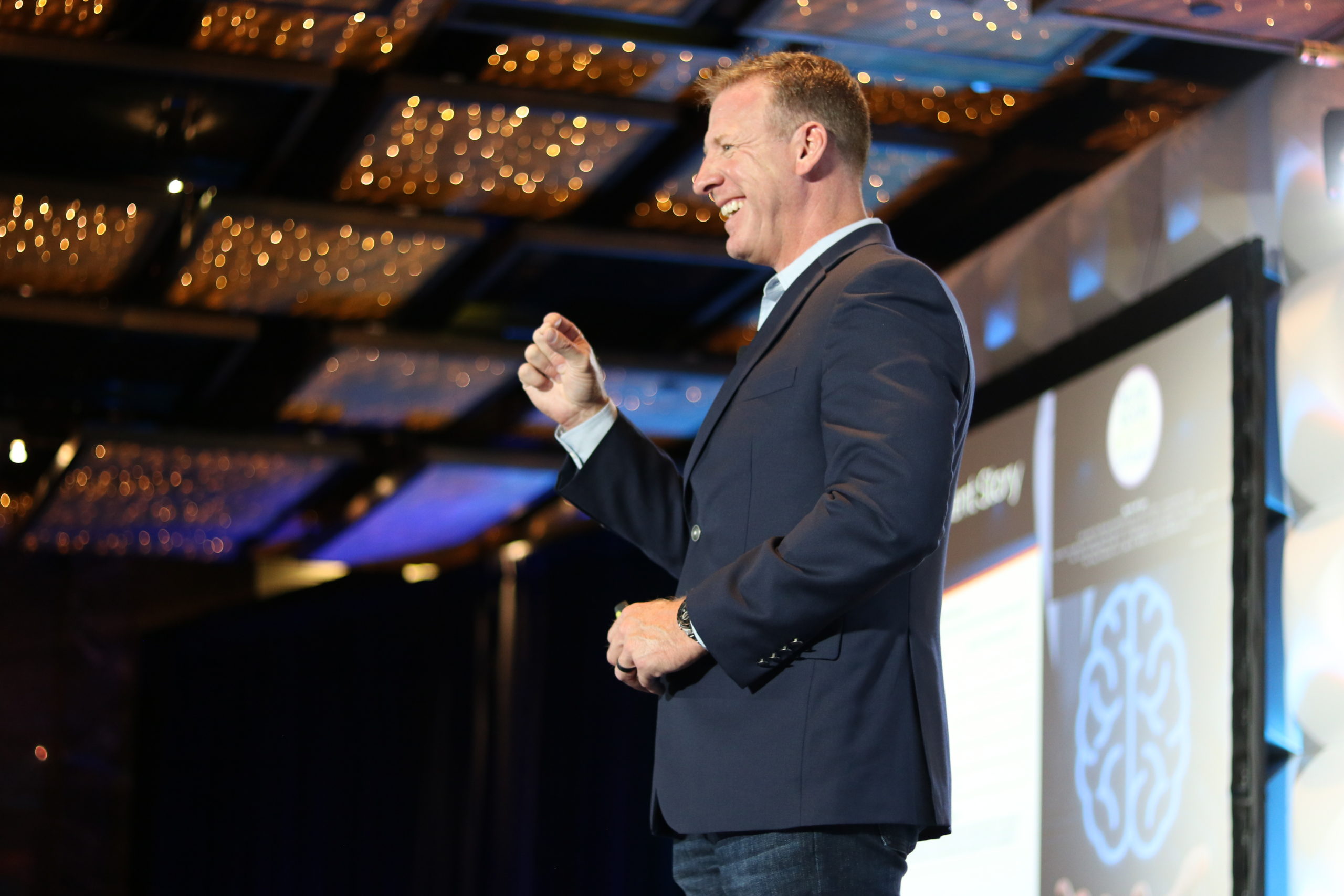
Jeff Bloomfield is a keynote speaker, Wall Street Journal bestselling author, and the founder of Braintrust. He has spent over 20 years helping Fortune 500 sales teams rewire how they communicate, using the neuroscience of trust, decision-making, and buyer behavior to drive results that training alone rarely produces. He speaks at corporate events, executive summits, and sales kickoffs across life sciences, financial services, software, and technology.
Experience Highlights
- 500+ keynotes delivered to Fortune 500 and association audiences
- Wall Street Journal bestselling author
- Former biotech executive who led launches for genetic cancer therapies
- 20+ years of Fortune 500 experience
- Founder of Braintrust
Areas of Expertise
AI was supposed to reduce cognitive load. In most organizations it has done the opposite, and the reason is uncomfortable once you see it. Your tools now generate more output in an hour than your people can meaningfully evaluate in a day, so the bottleneck moved from production to judgment. That is the mechanism behind the rise in cognitive overload at work: not more tasks, but more things demanding a decision from a brain with a fixed evaluation budget. If your team feels busier and simultaneously less confident in the calls it is making, this is why.
What Cognitive Overload Actually Is
Cognitive load is the total amount of mental effort a task demands from working memory at one time. Cognitive overload is what happens when that demand exceeds available capacity, at which point performance does not degrade gracefully. It drops off a cliff.
Working memory is the brain's temporary workspace. It holds the pieces of a problem while your prefrontal cortex compares them, weighs them, and reaches a conclusion. Its capacity is famously small and, more importantly, it is not expandable through effort or willpower. You cannot try harder into more working memory.
When capacity is exceeded, the brain does not stop working. It switches strategies. It abandons deliberate comparison and reverts to fast pattern matching: pick the familiar option, defer to the loudest voice, accept the first plausible answer, or postpone the decision entirely.
That last one is the expensive failure mode, because it looks like diligence.
AI Was Supposed to Reduce the Load
The business case for most AI deployments assumed a straight trade: the machine drafts, the human reviews, net effort falls. That math works when review is cheap. It breaks when review is the hard part.
Consider what actually happens. A manager who used to write one strategy memo now receives four generated versions and has to decide which framing is right. An analyst who used to build one model now gets six variants that all look internally consistent. A marketer who wrote three subject lines now evaluates forty. The production cost went to nearly zero. The evaluation cost went up.
Evaluative load, the mental effort required to judge, verify, and choose among options rather than create them, is the tax nobody budgeted for. And it is a heavier tax than creation, because judging plausible-looking alternatives requires holding all of them in working memory at once.
Not less work. Different work, in the one currency your team has least of.
What Happens in the Brain Under Sustained Overload
Three mechanisms matter for leaders.
The first is conflict monitoring. The anterior cingulate cortex flags mismatches between expectation and reality, which is what fires when a generated output is confidently wrong. That signal is metabolically expensive. Run it hundreds of times a day and the system starts suppressing it, which is the neurological version of rubber-stamping.
The second is threat detection. The amygdala treats ambiguity about status and competence as a genuine threat. When a tool can produce in seconds what used to take a person a week, the brain does not file that as convenience. It files it as a question about standing. Research consistently shows that under perceived threat, the brain narrows its options and reduces creative range, which is the exact opposite of what an AI transition requires.
The third is consolidation. Insight and pattern recognition depend on unfocused time when the brain's default mode network is active and connects information across contexts. Continuous evaluation eliminates that time entirely. Teams stop having ideas, then blame the calendar.
Why More Information Makes Decisions Worse Past a Threshold
Decision quality rises with information, then reverses. This is one of the more consistent findings in behavioral research, and the reversal point is lower than most executives assume.
Here is the mechanism. Additional information helps as long as it reduces uncertainty. Past a certain volume, new inputs mostly add contradictions rather than clarity, and each contradiction has to be resolved before a decision can close. The brain absorbs the cost of resolution, not the benefit of the data. Meanwhile confidence keeps climbing, because volume feels like rigor.
That gap between accuracy and confidence is where bad calls live.
Add loss aversion and the picture gets worse. Loss aversion is roughly 5x stronger than the desire for gain, so an overloaded decision-maker facing forty plausible options does not pick the best one. They pick the one least likely to be criticized. Multiply that across a leadership team and the organization drifts toward defensible mediocrity while every individual behaves rationally.
| Load Level | What the Brain Does | Visible Decision Behavior | Business Consequence |
|---|---|---|---|
| Optimal load | Deliberate comparison in working memory | Clear calls with stated reasoning | Speed and quality together |
| Rising load | Prioritizes familiar patterns | Faster calls, thinner rationale | Quality erodes invisibly |
| Overload | Suppresses conflict monitoring | Rubber-stamping, no dissent | Errors ship and compound |
| Sustained overload | Avoids the decision cost entirely | Deferral, escalation, more meetings | Cycle time collapses |
The New Attention Economics of Knowledge Work
For thirty years, the scarce resource in knowledge work was skilled output. It is now review capacity, and almost no organization has restructured around that shift.
Two effects compound the problem. The first is attention residue, the measurable degradation in performance that lingers after switching between tasks, because part of your attention remains allocated to the previous one. AI-assisted work multiplies switch frequency: prompt, read, judge, revise, prompt again. Each cycle leaves residue.
The second is cognitive offloading, the habit of outsourcing memory and reasoning to an external system. Offloading is not inherently bad. Calculators offloaded arithmetic and nobody mourns. But offloading judgment is different, because judgment improves through use and atrophies without it. A team that has stopped reasoning from first principles cannot evaluate the output of a system that reasons badly.
Meanwhile the environment is competing for the same attention. You have 5 seconds to capture or lose an audience, and your internal communication is being read in the same fragmented state as everything else.
Symptoms of Cognitive Overload in a Team
Overload rarely gets reported as overload. People report being busy. Watch for these patterns instead.
- Decisions that used to take one meeting now take three, with no new information in between.
- Nobody challenges AI-generated work in review, even when the room privately doubts it.
- Written output volume rises while the number of decisions closed per week falls.
- Senior people stop reading full documents and start asking for verbal summaries.
- Your highest performers report that they cannot think, not that they cannot cope.
- Errors are caught downstream by customers rather than upstream by teammates.
The last one is the reliable signal. When conflict monitoring is suppressed across a team, quality control migrates outside the building.
The Judgment Protection Framework
Protecting judgment is a design problem, not a discipline problem. Five steps, in this order.
- Cap the options before you generate them. Decide how many alternatives a decision warrants before you ask a model for any. Three is usually enough. Forty is an evaluation problem dressed up as thoroughness.
- Separate generation from evaluation in time. Never judge in the same session you generate. The brain state required for divergent production is not the state required for critical comparison, and switching between them within minutes produces the worst of both.
- Name the decision criteria first. Write down what would make one option better before you look at any of them. Criteria set in advance survive overload. Criteria invented during review are just preference.
- Assign a designated dissenter. One named person whose job in the review is to argue against the recommended output. This restores the conflict monitoring the team has learned to suppress, and it removes the social cost of being the only skeptic.
- Protect unstructured thinking time on the calendar. Not as a wellness perk. As the mechanism that produces the insight your AI tools cannot generate. Block it, defend it, and expect it to feel unproductive.
| What Most Leaders Try | Why It Fails | What Works Instead |
|---|---|---|
| Better prompt training | Increases output volume, worsens evaluative load | Cap options before generating |
| More review meetings | Adds switching cost and diffuses accountability | One review, criteria set in advance |
| Encouraging people to speak up | Ignores the social cost of dissent | Assign the dissenter role by name |
| Tool consolidation alone | Reduces friction, not decision density | Reduce decisions per person per week |
| Time management workshops | Treats a capacity problem as a habit problem | Redesign the workflow around review capacity |
How I Teach This From the Stage
My approach to this starts with a demonstration rather than a definition. I put an audience under a small, controlled cognitive load and let them feel their own judgment degrade in real time. Nobody argues with the data after that, because they just watched it happen in their own head.
Then we get specific about mechanism. I show audiences what their brain is doing when the volume exceeds capacity, why the resulting shortcuts feel like good instincts, and where the shortcut reliably fails. That is the core of the keynote "AI, Attention & Cognitive Overload," and it sits alongside "AI, Judgment & Decision-Making" and the flagship session "The Human Brain in the Age of AI" on my AI keynote speaker page.
The last third is always leadership language. Overload is transmitted downward through how leaders communicate, and 95% of communication is processed unconsciously, which means an anxious executive spreads load no matter how calm the memo sounds. My applied frameworks, NeuroSelling® for customer conversations and NeuroCoaching® for leadership conversations, give managers the specific sentence structures that lower threat response instead of raising it.
"Thanks to Jeff, we now have an understanding of the science of decision making and how the human brain actually builds connection and trust. This has made a huge impact on our results."
— Gary Price, Global Director of Sales, CSZ
Measuring Whether Judgment Is Recovering
Most organizations measure AI adoption by usage. Usage tells you almost nothing about whether decision quality is improving. Track these instead.
- Decisions closed per week per team, not documents produced.
- Reversal rate, meaning the share of decisions revisited within 30 days because the original call was wrong.
- Dissent frequency in reviews, tracked simply as whether anyone raised a substantive objection.
- Escalation rate, because rising escalation usually means people are avoiding the cost of deciding.
- Downstream defect origin, which tells you whether quality control still lives inside the team.
What Changes When You Get This Right
The upside is not modest. When evaluation capacity is protected, AI does deliver the compression everyone was promised, because a team that can judge quickly can safely accept more generated work.
That also happens to be where the durable roles are. An estimated 85 million jobs will be displaced by AI by 2028, and 97 million new roles will be created that require uniquely human skills. Judgment under ambiguity, trust-building, and the ability to decide with incomplete information sit at the center of that second number. Protecting attention is not a wellness initiative. It is workforce strategy.
Most organizations are optimizing the machine.
The advantage in the next three years goes to the ones optimizing the human evaluating its output. For a wider view of that shift, see how the same principles apply to leadership communication.
Frequently Asked Questions
How does AI affect attention span at work?
AI increases the frequency of task switching, because AI-assisted work runs in short prompt, read, judge, revise cycles. Each switch leaves attention residue that degrades performance on the next task. Average attention span is already down to 8 seconds from 12 seconds before smartphones, and AI-generated volume adds more decision points per hour to an already fragmented environment.
What is cognitive overload and how does it affect decision making?
Cognitive overload occurs when the mental demand of a task exceeds working memory capacity. Once that happens, the brain abandons deliberate comparison and reverts to shortcuts: choosing familiar options, deferring to authority, accepting the first plausible answer, or postponing the decision. Confidence often stays high while accuracy falls, which is what makes it dangerous.
Why did AI increase cognitive load instead of reducing it?
Because it lowered the cost of production without lowering the cost of evaluation. When a tool generates four plausible versions of a document, a human has to judge all four, and judging is more cognitively expensive than creating. The bottleneck moved from output to judgment, and few workflows were redesigned for that.
What are the signs my team is cognitively overloaded?
Decisions taking more meetings without new information, no one challenging AI-generated work in review, rising output volume alongside falling decision throughput, and errors being caught by customers rather than teammates. High performers saying they cannot think, rather than cannot cope, is the clearest early signal.
How do you protect decision quality when using AI?
Cap the number of options before generating any, separate generation from evaluation in time, define decision criteria in advance, assign a named dissenter in every review, and protect unstructured thinking time. Jeff Bloomfield teaches this sequence as a judgment protection framework in his keynote "AI, Attention & Cognitive Overload."
Is cognitive overload the same as burnout?
No, though they travel together. Burnout is a state of emotional exhaustion and disengagement built over months. Cognitive overload is an immediate capacity failure that can occur in a single afternoon and resolve with rest. Sustained overload is one of the more reliable paths into burnout, which is why leaders should treat it as a workflow design issue rather than a resilience issue.
Give Your Team Its Judgment Back
If your organization is generating more than it can evaluate, start a conversation with Jeff's team about a session built for your specific decision environment.
Keynote Speaker
Jeff delivers keynotes at sales kickoffs, leadership summits, and corporate conferences — combining neuroscience, storytelling, and real-world selling experience into sessions that move people and stick long after the event ends.
