

Trust Under Pressure: What Happens in the Brain When the Stakes Are High
About
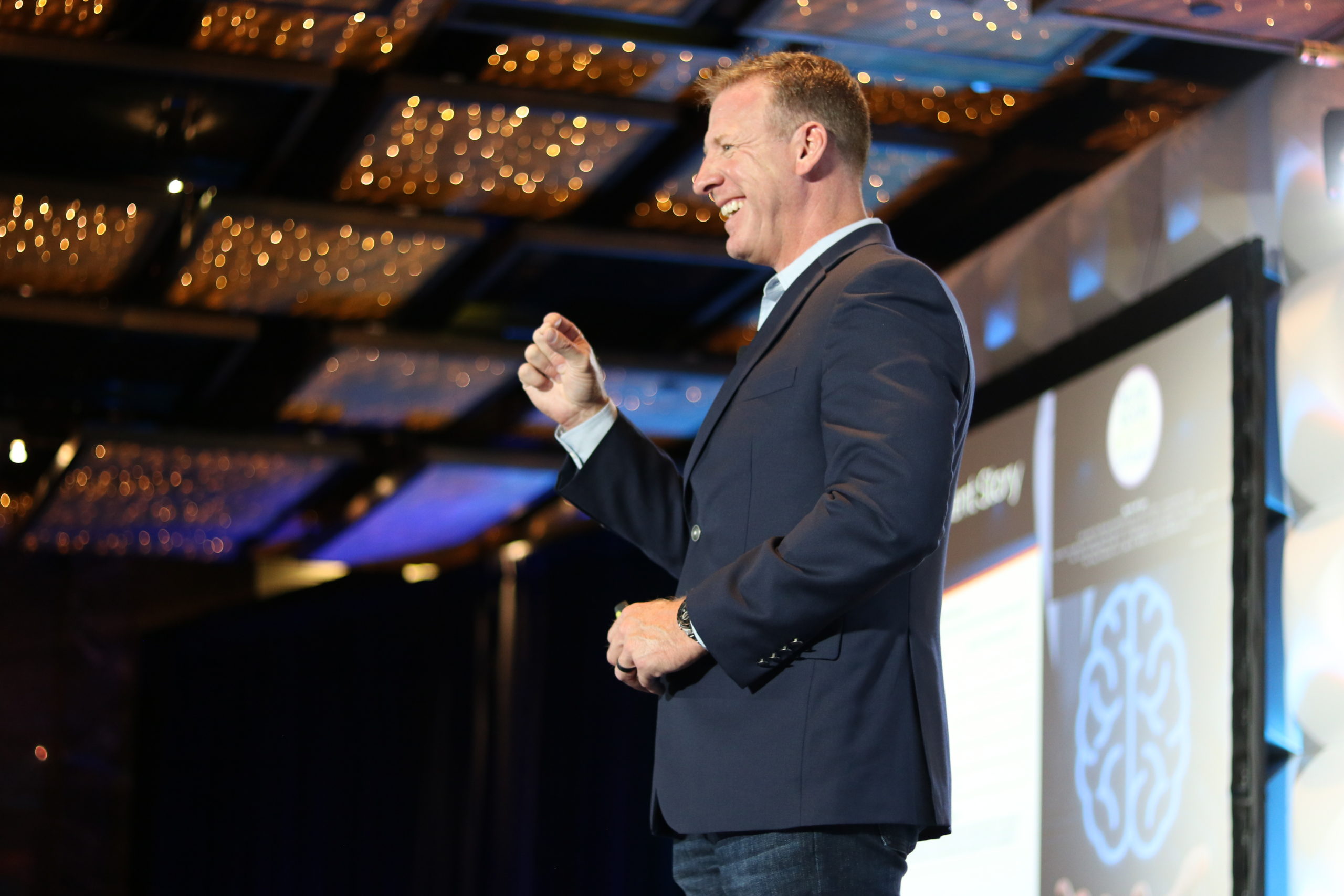
Jeff Bloomfield is a keynote speaker, Wall Street Journal bestselling author, and the founder of Braintrust. He has spent over 20 years helping Fortune 500 sales teams rewire how they communicate, using the neuroscience of trust, decision-making, and buyer behavior to drive results that training alone rarely produces. He speaks at corporate events, executive summits, and sales kickoffs across life sciences, financial services, software, and technology.
Experience Highlights
- 500+ keynotes delivered to Fortune 500 and association audiences
- Wall Street Journal bestselling author
- Former biotech executive who led launches for genetic cancer therapies
- 20+ years of Fortune 500 experience
- Founder of Braintrust
Areas of Expertise
Every leader has a trust score that looks fine on an ordinary Tuesday. The real number shows up the week the forecast misses, the reorg leaks, or the largest customer threatens to walk. Trust is not a fixed personality trait you either have or lack, it is a neurological state that rises and falls with perceived threat. If you want to know how to build trust under pressure, you have to start with what pressure actually does to the human brain, because the behaviors most leaders default to when the stakes spike are the exact behaviors that dismantle trust fastest. The encouraging part is that the mechanism is predictable, and predictable means trainable.
Trust Is a Neurological State, Not a Personality Trait
Most leadership content treats trust as a character attribute. You are trustworthy or you are not. Integrity, consistency, follow-through.
That framing is not wrong. It is incomplete, and it fails precisely when you need it most.
Trust, in behavioral neuroscience terms, is the brain's continuous assessment that another person is safe enough to be open with. It is not a verdict on your character. It is a calculation running below conscious awareness, weighing signals of safety against signals of threat. Trust is not stored as a belief. It is generated as a state.
States change. That is the entire point.
The leader who is warm, curious, and generous with information in January can become clipped, guarded, and directive in March, and the team's trust will track that change far faster than any engagement survey will catch it. Nothing about the leader's values shifted. What shifted was the perceived threat level, and the brain reallocated resources accordingly.
What Happens in the Brain When the Stakes Rise
Pressure is not a feeling. It is a physiological cascade with a documented sequence.
When the brain detects threat, and threat here includes ambiguity, status risk, public evaluation, and financial exposure rather than just physical danger, the amygdala fires before the thinking brain gets a vote. Threat response refers to this automatic, pre-conscious shift in which the brain reallocates energy away from reflection and toward protection. Cortisol rises. Attention narrows. The prefrontal cortex, the region responsible for perspective-taking, impulse control, and nuanced judgment, receives less bandwidth at exactly the moment you need more of it.
Here is the cruel design flaw. Every capacity trust depends on lives in the systems that pressure suppresses first.
| Capacity Trust Requires | How It Works at Normal Stakes | What Pressure Does to It | The Trust Cost in the Room |
|---|---|---|---|
| Perspective-taking | You automatically model what the other person is thinking and feeling | Narrows to self-protection and worst-case prediction | You stop reading the room and start defending your position |
| Generous interpretation | Ambiguous behavior gets a benign explanation | Ambiguity defaults to assumed hostile intent | A delayed reply becomes evidence of disloyalty |
| Openness to disconfirming input | New data quietly updates your view | Contradiction registers as personal attack | People learn to stop bringing you bad news |
| Emotional regulation | Tone stays steady, pace stays measured | Volume, speed, and edge all climb together | The team calibrates to your mood instead of the problem |
| Curiosity and question-asking | You ask before you conclude | Questions feel like wasted time | Statements replace questions and dialogue ends |
This is why "just stay calm under pressure" fails as advice. It asks the prefrontal cortex to solve a problem the amygdala already started.
Why Leaders Default to the Behaviors That Break Trust Fastest
Under pressure, capable people do not become careless. They become efficient in the wrong direction. Four defaults show up almost universally.
Certainty theater. The leader senses anxiety spreading and projects more confidence than the situation warrants. The intent is stabilizing. The effect is corrosive, because people feel the gap between the tone and the facts, and once they detect it they discount everything else you say.
Information compression. Communication gets shorter, more transactional, more decision-only. The leader is protecting bandwidth. The team experiences a sudden withdrawal of context and fills the vacuum with the worst available story.
Velocity over alignment. Pressure creates a bias toward action, so the leader moves to answers before establishing shared understanding of the problem. Research consistently shows that high-stakes conversations fail before they begin, not because people disagree on the answer, but because they were never aligned on the question.
Competence signaling. When status feels exposed, the brain reaches for proof of value: interrupting, correcting, restating credentials, answering questions nobody asked. All of it reads as self-focus, and self-focus is the fastest way to make other people guarded.
You do not get credited at the same exchange rate you get charged. That asymmetry is why trust feels slow to build and instant to lose.
The Observable Signals That Trust Is Eroding
Trust erosion rarely announces itself. It shows up as behavior that looks, on the surface, like cooperation. Leaders routinely misread these signals as good news.
| Signal You Can Actually Observe | What Leaders Usually Conclude | What Is Actually Happening | The Fastest Repair Move |
|---|---|---|---|
| Meetings get shorter and more agreeable | "We are finally aligned" | Threat response is suppressing dissent; people are optimizing to look right | Ask for the strongest objection by name, then thank the person who gives it |
| Questions migrate to hallways and direct messages | "Minor grumbling, normal noise" | Public channels are being read as unsafe | Answer the hallway question in the open, without punishing the source |
| Updates arrive polished and late | "The team is being thorough" | People are buying time to manage your reaction | Publicly reward early, unfinished, unflattering disclosure |
| Strong performers stop volunteering ideas | "They are heads-down and busy" | The cost of a rejected idea now exceeds the perceived upside | Separate idea generation from idea evaluation by at least a day |
| You start hearing "whatever you think is best" | "Deference and respect" | Compliance is quietly replacing commitment | Refuse to decide until you hear their recommendation first |
Read that table as a diagnostic. If three or more showed up last quarter, the issue is not engagement. It is safety.
What Changes When a Leader Holds Trust Under Pressure
Low-trust teams under pressure produce safe thinking. High-trust teams under pressure produce sharp thinking. That is the whole difference, and it compounds.
Not because high-trust teams are more optimistic. Because they spend less energy on self-protection and more on the actual problem.
When trust holds, bad news travels at the speed it needs to and dissent arrives early enough to be useful. Most leaders assume they get those things automatically because they asked for them. They do not. The brain does not respond to invitations, it responds to evidence.
Employees are 3.5x more engaged when leaders communicate with empathy, and pressure is exactly when empathy stops being automatic.
A Five-Step Framework for Holding Trust When the Stakes Spike
This sequence works because it interrupts the threat response before it drives behavior, rather than trying to override behavior after the fact.
- Name the pressure out loud before you act on it. Say the stakes plainly: "This number matters, I feel the urgency, and I am going to slow us down for four minutes anyway." Labeling the state reduces its grip on you and tells the room the tension is shared rather than aimed at them.
- Protect the first 90 seconds. The opening moments of a high-stakes conversation set the threat baseline for everything after. Lead with the other person's reality, not your agenda. One genuine question about their situation buys more openness than ten minutes of your reasoning.
- Lead with what you do not know. Certainty theater invites disbelief. Naming the things you cannot yet answer, with a date when you will, is what actually calms a room. Uncertainty is tolerable. Being managed is not.
- Separate the decision from the conversation. State upfront whether you are gathering input or announcing a call already made. Most trust damage comes from blurring those two, because people invest emotional energy in a decision that was never open.
- Close the loop in public. Tell people what you did with what they gave you, including the input you rejected and why. Unclosed loops teach the brain that contribution is not worth the risk.
None of this requires new information. It requires deciding in advance, while your prefrontal cortex is still fully online, how you intend to behave when it is not.
How I Teach Trust Under Pressure From the Stage
My approach comes from two places: behavioral neuroscience, and a biotech career launching genetic cancer therapies, where no amount of clinical data moved anyone who did not trust the person delivering it.
In keynotes like The Science of Trust and The Trust Advantage, I do not ask audiences to be more trustworthy. I show them the mechanism: what their own brain does in the first seconds of a threatening conversation, why the instinct to explain harder makes things worse, and what sequence overrides it. NeuroCoaching®, the leadership framework I built at Braintrust, exists for that reason, to give leaders a repeatable way to run trust-based conversations when the pressure is on.
The reaction I get most often is relief. Leaders have been told for years that trust is a matter of character, which leaves them nowhere to go when they behave badly under stress. Seen as a state, it becomes practiceable.
"Thanks to Jeff, we now have an understanding of the science of decision making and how the human brain actually builds connection and trust. This has made a huge impact on our results."
— Gary Price, Global Director of Sales, CSZ
Across 500+ keynotes, this is the material that changes behavior in the following week rather than the following quarter. The leadership keynote speaker page covers formats and audience fit, and my background explains where the science came from.
Trust Under Pressure in the Buyer Conversation
The same mechanism governs revenue. A seller walking into a renewal at risk or a first meeting with an economic buyer carries the same cortisol load as any executive, with the same predictable consequences.
The brain forms a first impression in roughly 0.07 seconds, so the buyer's threat assessment is complete before the seller finishes the opening sentence. Under pressure, sellers compress, accelerate, and over-explain. The buyer's brain reads urgency as self-interest and goes guarded.
NeuroSelling®, the sales methodology I built on the same neuroscience, reshapes the opening so the buyer's brain registers safety before it evaluates content. The overlap with leadership is not a coincidence. It is the same organ. Revenue teams can start with the sales keynote speaker overview.
Build the Capacity Before You Need It
You cannot install trust during a crisis. You can only spend what you deposited earlier. The practices below are deliberately small, because repetition at low stakes is what makes the behavior available at high stakes.
| Practice | Cadence | What It Protects When the Stakes Spike |
|---|---|---|
| Write down your three pressure tells and share them with your team | Once, revisited annually | Gives people language to flag your threat state before it does damage |
| Ask one direct report for the thing they are least comfortable telling you | Weekly | Keeps the dissent channel warm so it still works in a crisis |
| Run a five-minute pre-mortem on your own behavior before hard meetings | Per high-stakes meeting | Pre-commits the response while your judgment is still fully available |
| Publicly credit a piece of input you initially resisted | Monthly | Proves that contradicting you is survivable, which is the only proof that counts |
| Debrief trust, not just outcomes, after every crisis | Per event | Converts a pressure episode into a durable capability instead of a scar |
Measuring this is simpler than most leaders expect. Track how early bad news reaches you, how often someone disagrees with you in a group setting, and how fast decisions turn into visible action. Those three indicators move before any survey does.
Frequently Asked Questions
Why does trust break down in high-stakes moments?
Because pressure triggers a threat response that suppresses the exact brain functions trust depends on: perspective-taking, generous interpretation, emotional regulation, and openness to disconfirming input. The behaviors that replace them, projecting false certainty and moving to fixes too fast, read as self-focus. People go guarded, and the leader usually mistakes that guardedness for agreement.
How do you build trust under pressure as a leader?
Decide your behavior in advance, because you will not improvise it in the moment. Name the pressure out loud, lead with the other person's reality, state what you do not know, distinguish between gathering input and announcing a decision, and close the loop publicly. Jeff Bloomfield teaches this as a five-step sequence precisely because it has to be repeatable rather than intuitive.
Is trust a skill or a personality trait?
Closer to a skill, though the most accurate description is a state you learn to produce. Character matters, but it does not explain why the same leader generates high trust in calm conditions and low trust under stress. Because the trust state has identifiable triggers and countermoves, it can be trained like any other performance capability.
What are the early warning signs that a team no longer trusts its leader?
Watch for meetings that get shorter and more agreeable, questions moving to hallways and direct messages, updates arriving polished and late, and strong performers going quiet. Each looks like cooperation on the surface. All of them mean people have concluded candor is more expensive than silence.
Does psychological safety mean avoiding hard conversations?
No, and that inversion is a common misread. High trust makes hard conversations possible rather than unnecessary, because people can absorb difficult feedback without processing it as a threat to their standing. Low-trust teams avoid hard conversations; high-trust teams have them earlier.
What kind of keynote actually changes how leaders behave under pressure?
One that explains the mechanism rather than delivering encouragement. Jeff Bloomfield's talks, including The Science of Trust and The Trust Advantage, walk audiences through what happens in their own brain during a high-stakes exchange and give them a behavioral sequence to run instead of their default. Audiences leave with something usable in their next hard conversation.
Bring This to Your Leadership Team
If your leaders are strong on an ordinary Tuesday and inconsistent when the stakes spike, that is a mechanism problem, not a character problem. Start a conversation about what this looks like for your team.
Keynote Speaker
Jeff delivers keynotes at sales kickoffs, leadership summits, and corporate conferences — combining neuroscience, storytelling, and real-world selling experience into sessions that move people and stick long after the event ends.
