

Why Employees Don't Trust New AI Tools, and What Leaders Can Do About It
About
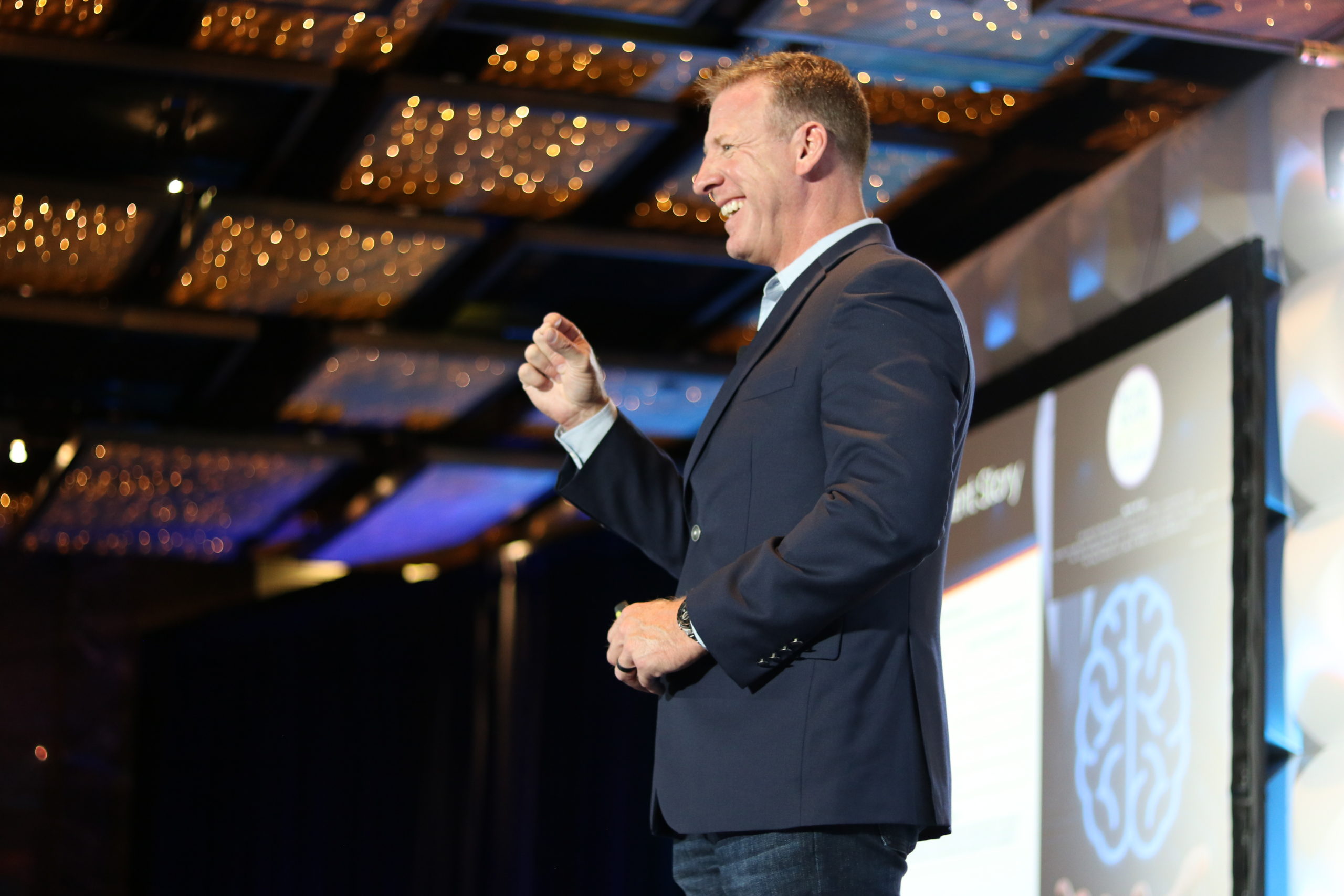
Jeff Bloomfield is a keynote speaker, Wall Street Journal bestselling author, and the founder of Braintrust. He has spent over 20 years helping Fortune 500 sales teams rewire how they communicate, using the neuroscience of trust, decision-making, and buyer behavior to drive results that training alone rarely produces. He speaks at corporate events, executive summits, and sales kickoffs across life sciences, financial services, software, and technology.
Experience Highlights
- 500+ keynotes delivered to Fortune 500 and association audiences
- Wall Street Journal bestselling author
- Former biotech executive who led launches for genetic cancer therapies
- 20+ years of Fortune 500 experience
- Founder of Braintrust
Areas of Expertise
Your company bought the licenses. Your people sat through the training. Six weeks later usage is flat, half the seats have never been opened, and the internal narrative has quietly settled on "our team is resistant to change." Most organizations diagnose that as an enablement gap and respond with more sessions, more champions, and eventually a mandate. The diagnosis is wrong. Employees resist AI tools for reasons that have almost nothing to do with whether they understand the interface and almost everything to do with whether they believe the tool is safe for them, and safety is a trust question the brain settles long before it evaluates a single feature.
The Diagnosis Most Companies Get Wrong
When adoption stalls, two explanations dominate the room.
The first is a training problem. People do not know how to use it, so we teach them again.
The second is a change management problem. People are uncomfortable with change, so we communicate more, appoint champions, and build a comms cadence.
Both share a hidden assumption: resistance is an information deficit. Give people enough clarity and competence and behavior follows.
It does not, because AI adoption resistance is not a refusal to learn. It is a protective response to a perceived threat to status, security, and professional identity. And a threat response does not resolve with information. It resolves with evidence of safety.
Not one hour of feature instruction answers the question the employee is actually asking.
What Employees Are Actually Reacting To
They are not reacting to the tool. They are reacting to what the tool signals about their future.
Sit in enough rollout conversations and the same unspoken questions surface every time:
- If this works well, does my headcount survive the next planning cycle?
- Who decided this, and were people doing my job in the room?
- Will my output be judged against what the tool can produce?
- Is my usage being monitored, and by whom, and for what purpose?
- If I raise a concern, will I be labeled as resistant?
Every one of those is a trust question, not a skills question.
There is also a credibility problem that predates the technology. Research consistently shows executives express far more confidence in AI-supported decisions than frontline employees do, and that gap is not about technical literacy. Half of all employees have quit a job because of a manager. Trust in the tool is downstream of trust in the person introducing it.
What the Brain Does When a Tool Threatens Your Role
Here is the mechanism, and it is not metaphorical.
When the brain detects a threat to status, certainty, or autonomy, the amygdala triggers a protective cascade before conscious reasoning engages. Threat response refers to that automatic reallocation of energy away from reflection and toward self-protection. Cortisol rises, attention narrows to the source of the risk, and the prefrontal cortex, the region that handles curiosity, experimentation, and tolerance for ambiguity, gets less bandwidth.
Learning requires exactly the state that threat suppresses.
That is why adoption training produces attendance without behavior change. You can put someone in a session, but you cannot install curiosity in a brain that is defending itself. Loss aversion compounds it: because the brain weighs potential loss roughly five times more heavily than equivalent gain, the upside of a productivity tool never balances the downside of a diminished role. That math is not close, and it is running in every person in the room.
Most leaders assume ambivalence toward AI is intellectual. It is physiological.
Why "AI Will Augment You, Not Replace You" Fails
This is the most repeated sentence in corporate AI communication, and it reliably makes things worse. Not because the intent is bad. Because it is an unverifiable promise about the one thing the listener most needs verified, and the brain treats unverifiable reassurance as a signal that risk exists.
| What Leadership Says | What Employees Actually Hear | Why the Brain Lands There |
|---|---|---|
| "AI will augment you, not replace you" | "Somebody has already mapped which parts of my job are replaceable" | An unverifiable promise about job security prompts scrutiny instead of relief |
| "This frees you up for higher-value work" | "My current work is low value, and by extension so am I" | Reframes identity as overhead, which registers as status threat |
| "We are just experimenting for now" | "Nobody will tell me what happens if it succeeds" | Ambiguity is processed as threat, not as neutrality |
| "Adoption is now a performance metric" | "I am being scored on cooperating with the thing that may replace me" | Coercion converts ambivalence into compliance and produces usage theater |
| "Everyone needs to become AI-first" | "There is a new standard and no one has told me how I measure against it" | Undefined standards maximize evaluation anxiety |
Read the middle column carefully. None of those interpretations are irrational. They are what a threat-primed brain does with incomplete information, which is fill the gap with the most protective available story.
Your workforce is not naive. They have absorbed the displacement headlines. Vague optimism from leadership does not compete with a number they already know.
The Four Trust Conditions AI Adoption Requires
Adoption follows trust, and trust under these circumstances is not a mood. It is four specific conditions being satisfied. Miss any one and usage stays performative.
- Security clarity. Name the headcount question out loud rather than waiting to be asked. State what you know, what you do not know, and when you will know more. "I cannot promise this organization never changes shape, and I can tell you that no reduction is planned tied to this rollout, and I will tell you directly if that changes." Specific and bounded beats warm and vague every time.
- Decision transparency. Say who selected the tool, what problem it was chosen to solve, what alternatives were considered, and how you will judge whether it worked. Opacity about the decision is read as opacity about the motive.
- Genuine autonomy. People need real influence over how the tool fits their work, including the ability to say "not for this task" without a penalty. Involvement in design is what converts something being done to them into something they are doing. This is the single most underused lever in most rollouts.
- Evaluation fairness. Be explicit about how AI-assisted output affects how their work is assessed, what will and will not be monitored, and who sees usage data. Unstated measurement is the fastest route to quiet non-adoption.
Notice that none of these four are features of the tool. All four are behaviors of the leader.
What Leaders Should Say and Do Instead
The fix is rarely a better deck. It is a different set of moves.
| Stop Doing This | Do This Instead | What It Resolves |
|---|---|---|
| Opening with capability demos | Opening with the specific problem the tool was chosen to fix, in their language | Establishes intent before the brain assigns motive |
| Promising nobody will be replaced | Naming what you know, what you do not, and your commitment to tell them first | Replaces an unverifiable promise with a verifiable behavior |
| Mandating usage metrics | Asking teams to define where the tool should and should not be used | Restores autonomy, which lowers the threat signal directly |
| Sending champions to evangelize | Having managers visibly use the tool and talk openly about where it failed them | Modeling is evidence; enthusiasm is just tone |
| Treating objections as resistance | Publicly rewarding the sharpest objection in the room | Proves that candor is survivable, which is the only proof that counts |
| Announcing wins only | Reporting what you changed based on employee input, including what you rejected | Closes the loop, so contributing feels worth the risk |
Research consistently shows that when managers actively use these tools rather than simply endorsing them, employee trust rises substantially. Not because usage is contagious. Because visible use by someone with more to lose is the closest thing to proof the brain will accept.
How I Frame This With Leadership Teams
I show audiences the brain scan version of their own rollout. In keynotes like The Human Brain in the Age of AI and Leading Humans in an AI-Driven Workplace, I walk leadership teams through what happens neurologically in the twenty seconds after an employee hears that a new tool is coming, and why the reassurance they instinctively reach for is the exact sentence that raises suspicion.
I am not a technologist and I do not predict which model wins. My work sits on the human side, which is where adoption succeeds or fails. NeuroCoaching®, the leadership framework I built at Braintrust, exists to give leaders a repeatable way to run these conversations: how to open, how to handle the security question directly, and how to convert compliance into commitment.
The reframe that lands hardest is this one. 97 million new roles are projected to require uniquely human skills, which means the strategic question is not whether your people will use the tools. It is whether they trust you enough to tell you the truth about what the tools cannot do.
"Jeff not only inspired our leaders, but had everyone thinking differently about how we coach and communicate in every area of our company."
— Matt E., CEO
If you are building this into a leadership summit or all-hands, the AI keynote speaker page covers formats and audience fit, and the leadership keynote speaker page covers the trust and coaching side of the same problem.
A Rollout Sequence That Builds Trust Instead of Resistance
Sequence matters more than content, because the first message sets the threat baseline for everything after.
- Answer the security question before you demo anything. The first communication should address employment, evaluation, and monitoring. Capability comes second, and it lands differently once the threat is addressed.
- Recruit skeptics, not just enthusiasts, into the pilot. The people with the strongest objections have the most accurate map of where the tool will break. Including them signals that dissent has standing.
- Let the teams doing the work define the boundaries. Where it helps, where it does not, and what stays human by default. Boundaries set by the people affected are respected; boundaries set for them are worked around.
- Make managers demonstrate before they measure. No usage target lands credibly from someone who has not used the tool in front of their team, including the times it produced something useless.
- Report back what changed because of employee input. Publicly, by name where appropriate, including the input you declined and why. Unclosed loops teach people that participation is not worth the exposure.
None of these steps requires new technology. All of them require a leader willing to go first.
How to Tell Whether Trust Is Actually Improving
Most AI dashboards measure activity and call it adoption. Activity is the easiest metric to fake and the least predictive of value.
| Signal Worth Tracking | What It Actually Tells You | What Dashboards Usually Measure Instead |
|---|---|---|
| Employees reporting where the tool failed them | People believe honest feedback is safe and useful | Total prompts, sessions, or seats activated |
| Teams proposing new use cases unprompted | Ownership has replaced compliance | Completion rates on required training |
| Depth of use in high-stakes work, not just low-stakes drafts | Genuine confidence in the output | Logins per week |
| Questions asked in open forums rather than private channels | The public channel is being read as safe | Survey sentiment scores collected anonymously |
| Voluntary usage persisting after the mandate lapses | Real behavior change rather than usage theater | Peak adoption during the rollout window |
Track those five and you will know within a quarter whether you built trust or just built traffic.
Frequently Asked Questions
Why do employees resist AI tools even after training?
Because resistance is a threat response, not a knowledge gap. When a tool could plausibly absorb part of someone's job, the brain processes it as a risk to status and security, and that state suppresses the curiosity learning requires. Training addresses capability, not whether the employee believes the tool is safe for them.
How do you get employees to trust AI at work?
Satisfy four conditions: security clarity, decision transparency, genuine autonomy over where the tool is used, and explicit fairness about how AI-assisted work gets evaluated. Address the employment question before any capability demonstration, and have managers visibly use the tool themselves, including in the moments it fails. Jeff Bloomfield teaches this as a leadership behavior sequence rather than a communications plan, because employees respond to evidence rather than messaging.
Why does "AI will augment you, not replace you" backfire?
It is an unverifiable promise about the exact thing the listener most needs verified, and the brain reads unverifiable reassurance as confirmation that risk exists. It also implies someone has already assessed which parts of the job are replaceable. Stating what you know, what you do not, and your commitment to communicate changes first is more credible than a guarantee nobody can enforce.
Is AI resistance a change management problem or a trust problem?
Trust, and the distinction changes what you do about it. Change management assumes resistance comes from discomfort with the unfamiliar and treats it with communication volume. Trust framing assumes resistance comes from perceived risk and treats it with transparency, autonomy, and verifiable leader behavior.
What should a leader say in the first AI announcement?
Lead with the problem the tool was chosen to solve, in the employees' own language. Then address employment, evaluation, and monitoring directly, including what you cannot promise, and explain who decided and how success gets judged. Capability demos belong after all of that, not before.
What kind of keynote helps a workforce get past AI anxiety?
One built on how the brain processes threat rather than one forecasting which technologies win. Jeff Bloomfield's talks, including The Human Brain in the Age of AI and Leading Humans in an AI-Driven Workplace, give leaders and employees a shared explanation for why the anxiety exists and the behaviors that resolve it. Audiences leave with language for the next team conversation, not a longer list of worries.
Bring This to Your Leadership Team
If your AI investment is stalling and the diagnosis so far has been "more training," the problem is probably upstream of the tool. Start a conversation about what a trust-first rollout looks like for your organization.
Keynote Speaker
Jeff delivers keynotes at sales kickoffs, leadership summits, and corporate conferences — combining neuroscience, storytelling, and real-world selling experience into sessions that move people and stick long after the event ends.
